
Link Building Strategies That Work in 2026: Start With What You Already Have
Data, a product, relationships, content, time or money: 13 link building strategies sorted by what you already have, with hours, first steps and a 12-week example plan.
Hamza Haroon
· 16 min read
What do you already have that could earn a link: data nobody else has collected, a product people use, relationships, published content, spare hours, or a budget? Your answer decides which link building strategies deserve your next three months.
Give the largest share of your hours to the asset your competitors can't copy. Fill the waiting time with quick requests that use the others.
How to choose a backlink strategy
A backlink strategy is a plan for which links to go after, who does the work and how many hours it gets. Lists of backlink strategies usually rank tactics from best to worst, as if every site set off from the same place. The best backlink strategy for a software company with years of usage data is a poor one for a two-person bakery, because it rests on something the bakery doesn't have. Think of your assets as six metro lines. Three questions tell you where to board:
- What could only you publish or build? Numbers from your own work put you on the data line. Something people use puts you on the product line.
- Who would answer your email this week? Suppliers, customers, partners and groups you belong to put you on the relationships line.
- What's left over? Good pages, spare hours or a budget put you on the content, time or money line.
Below are 13 strategies on those six lines. Each has the same four notes: who it suits, how to start this week, hours, and the sign it's working. The hours are our planning estimates for a first attempt by a small team. They aren't measured averages, so log your own for a month and replace ours. That gives you a backlink strategy SEO and marketing can put in the same calendar.
Types of link building strategies: earned, asked for and placed
There are three types of link building strategies: earned (someone links on their own terms), asked for (a site owner says yes to your request) and placed (you add the link within the host's rules). They differ in who decides.
| Type | Who decides | Strategies on this page | Question to ask first |
|---|---|---|---|
| Earned | A writer, editor or reader, on their own terms | Original study, digital PR, free tool or template, communities and events, journalist requests | Would a stranger cite this? |
| Asked for | A site owner who answers your email | Partners and suppliers, unlinked mentions, lost links, resource pages, dead links | Is their page better with your link in it? |
| Placed | You, within the host's rules | Integration listings, guest posts, niche edits | Would you still want it if it passed no ranking credit? |
Most link building techniques in SEO are one of these three with a different opening move. Quality link building techniques pass one test whatever the type: the host page is more useful to its readers once your link is there. What sits on the page afterwards is another question, and the kinds of links you can end up with vary more than the strategies do. Earned and asked-for work, with no payment on either side, is roughly what people mean by white hat link building strategies.
If you have data
Any business that counts things has data: orders, prices, support tickets, test results, delivery times. This line is slow to start and hard to copy.
Publish an original study
Pick one question your market argues about, answer it with your own numbers, and publish the method beside the result. Reporters ask for this: 40% of the journalists in Muck Rack's 2026 survey want original data or research with a pitch (897 responses, 30 January to 2 March 2026).
- Suits: anyone with enough records to publish a pattern without naming customers.
- Start this week: export one table, write the headline you hope it supports, then check whether it does.
- Hours: 20 to 40, most of it cleaning and checking.
- Working when: a site you never contacted quotes your number and names you.
Pitch the finding as digital PR
Digital PR takes one finding to the reporters who cover that subject. In the same survey, 88% of journalists said they drop pitches that fall outside their coverage, so spend the time on choosing names and keep the list short.
- Suits: a study, a price index or a local angle a newsroom can use.
- Start this week: list ten reporters who covered the subject in the past three months, and note what each story was missing.
- Hours: 8 to 15 per story, with one follow-up.
- Working when: reporters write back with questions, even if this story doesn't run.
That's one line finished. Here is the whole network with all 13 strategies on it. Where two lines share a station, either asset will get you there.
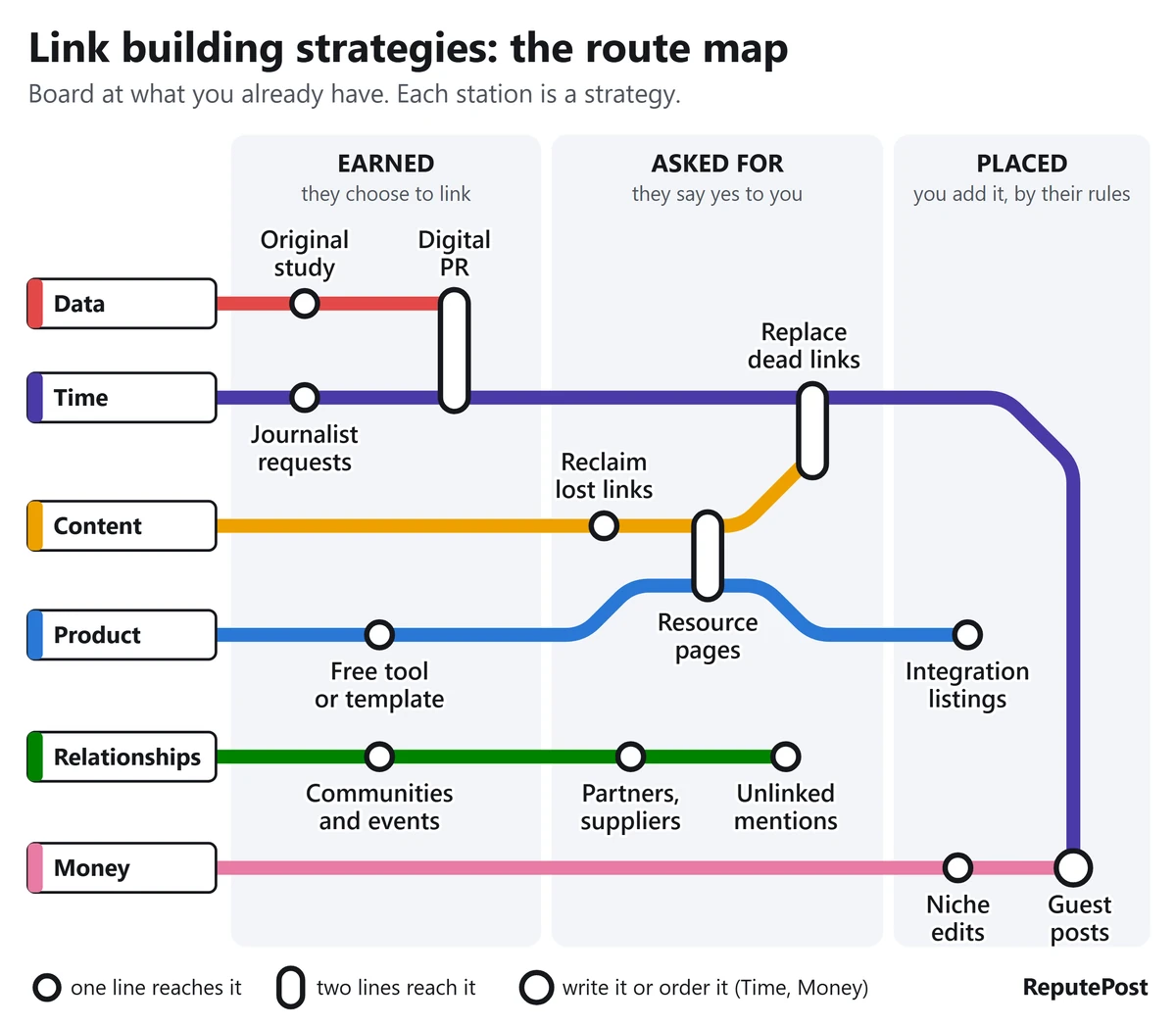
The route map: six lines for what you already have, 13 stations for the strategies, and three zones for who decides the link. White capsules and the large ring mark strategies that two lines reach.
If you have a product
Products earn links when people can use a piece of them without paying, or when another product lists them.
Give away a free tool or template
Take one job your customers do by hand and build the smallest thing that does it: a checklist, a spreadsheet, a calculator. Templates take less work than tools and are easier to keep current.
- Suits: teams whose buyers repeat the same sum or form every month.
- Start this week: ask support which spreadsheet customers keep requesting, and tidy that one.
- Hours: 6 to 10 for a template, 20 to 40 for a simple calculator.
- Working when: visits arrive from pages you've never pitched.
Get listed on integration pages
If your product connects to another, both companies usually have a page for it, and app directories hold many more. Some cost only your time: Zapier says an integration is free to build. Publish the integration page on your own site first, so the listing has something specific to point at.
- Suits: software, apps, plugins, and anything sold on a platform with a directory.
- Start this week: list every tool yours connects to, and mark the directories you're missing from.
- Hours: 4 to 8 per listing once the integration works.
- Working when: new sign-ups name the directory as the place they found you.
If you have relationships
These links come from people who already know your name, so the first email can be short.
Ask partners and suppliers
Many firms publish a page naming their suppliers, stockists, clients or members. If you belong on one, ask to be added where it helps their visitors. For an online shop that means the stockist page of each brand it sells, a sensible start for ecommerce link building strategies. Don't offer a swap; the last section explains why.
- Suits: businesses with trade accounts, certifications or memberships.
- Start this week: pull the company names from last year's invoices, both directions, and open each one's partner or customer page.
- Hours: 2 to 4 for the list and the first emails.
- Working when: you're listed on pages their customers visit.
Claim unlinked mentions
Somebody wrote about you and left out the link. You're asking a person who already found you worth naming for one small fix. Google Alerts will watch for the next one.
- Suits: brands, founders and products with a distinctive name.
- Start this week: set alerts for your brand, product and founder names in quotes, then search each for the past year.
- Hours: 2 to 3 to set up and search, then about 1 a month.
- Working when: writers add the link without asking for anything back.
Show up in communities and events
Answer questions where your buyers talk, and speak at the meetups they attend. The link is a by-product: an organizer lists the speakers, or a member writes up the answer that worked.
- Suits: founders and specialists who like explaining things.
- Start this week: choose one community, and answer three open questions without linking to yourself.
- Hours: 1 to 2 a week, so 4 to 8 in the first month.
- Working when: people tag you into threads, or an organizer asks you back.
If you have content
Pages you published years ago may have lost links, and some answer questions that other sites keep lists about.
Reclaim the links you've lost
Here somebody has already said yes. Export every link Google shows you, open the pages that get the most, and fix any that return an error or redirect somewhere unrelated. Then write to sites that dropped your link by accident, in a redesign for example. We missed one ourselves: after we rebuilt this site on 30 September 2026, a deleted post with links from two other sites returned a 404 until we redirected it in early November.
- Suits: sites older than two years, and any site that has moved or been rebuilt.
- Start this week: check the status code of your 50 most linked pages.
- Hours: 3 to 5 for the first pass, then about 1 a month.
- Working when: old links land on live pages and the number of linking domains stops falling.
Pitch resource pages
Libraries, universities, councils, trade bodies and hobby sites keep lists of useful pages. Those pages exist to link out, so one that fills a gap is a fair request. Before you write, check the list has been edited in the past year and how closely its topic matches yours.
- Suits: guides, tools and data pages with no sales pitch in them.
- Start this week: search your topic with
intitle:resourcesand save 20 live lists. - Hours: 4 to 6 per batch of 20 to 30 prospects.
- Working when: curators reply, and list you beside sources you respect.
If you have time
No data, product or contacts yet? Two strategies ask for little except steady hours.
Answer journalist requests
Reporters post questions and quote whoever answers well. HARO is free and sends up to three digests of requests each weekday. Answer only what you know first-hand, because its about page says it now has safeguards against spam and AI-generated content.
- Suits: people with a job title or track record a reporter can check.
- Start this week: sign up, pick one beat, and send two answers under 150 words with a line on who you are.
- Hours: 2 to 3 a week, so 8 to 12 in the first month.
- Working when: a reporter comes back to you directly.
Replace dead links
This is broken link building: find a dead page that others still link to, publish something that meets the same need, and tell those sites. Supply isn't a problem. Pew Research Center reported in May 2024 that 38% of webpages from 2013 were gone a decade later, and that 23% of the news pages it sampled held at least one broken link. You can borrow email scripts for dead and dropped links.
- Suits: teams that can write a better page than the one that died.
- Start this week: list five sites your market used to cite that have since closed.
- Hours: 10 to 15 for the first batch, plus writing time if you need a new page.
- Working when: owners swap your page in. If they fix the link with someone else's, yours wasn't the match.
If you have money
We sell both strategies on this line, so weigh our view with that in mind. One rule covers them. Google's spam policies, last updated on 23 November 2026, treat buying links for ranking purposes as link spam. Links bought for advertising or sponsorship are allowed when they carry rel="sponsored" or rel="nofollow", and labelling a paid link takes one attribute. A budget can also buy hours instead of placements, so price up in-house, freelance and agency help before you spend it all on links.
Write guest posts
You write an article for another site's readers, and it links back to you. With more hours than budget, pitch sites that still take outside articles. With more budget than hours, compare publisher sites on ReputePost, where a person checks every site and prices start from $6.50.
- Suits: sites that can explain one subject better than their competitors.
- Start this week: choose three pages that need links, and write the question each one answers for someone else's reader.
- Hours: 6 to 10 per post if you pitch and write it, 1 to 2 if you order it (brief, check, log).
- Working when: the article itself gets readers, and the link is still there 90 days later.
Add niche edits to live articles
The link goes into an article that's already published and indexed, either through your own outreach or an order with ReputePost's niche edit team. Judge the page first and the site second: topic, its own traffic, and how many outside links it already holds.
- Suits: a page that deserves a mention in articles that exist already.
- Start this week: find three indexed articles where your page would answer a reader's next question.
- Hours: 1 to 2 per order (check the page, approve the sentence, confirm it's live).
- Working when: the host page keeps its traffic and people click through.
The money line is the one our own case study used most. A new site launched on 10 September 2023 began with profile listings, then added guest posts on 15 sites, 41 niche edits and 12 paid editorial placements. Its main pages reached the top five on day 130, and it passed 33,500 Google clicks by the end of January 2024. The paid placements come under the rule above, and this is one site in one niche, so read what was built in each phase as an example of order. It can't forecast your results.
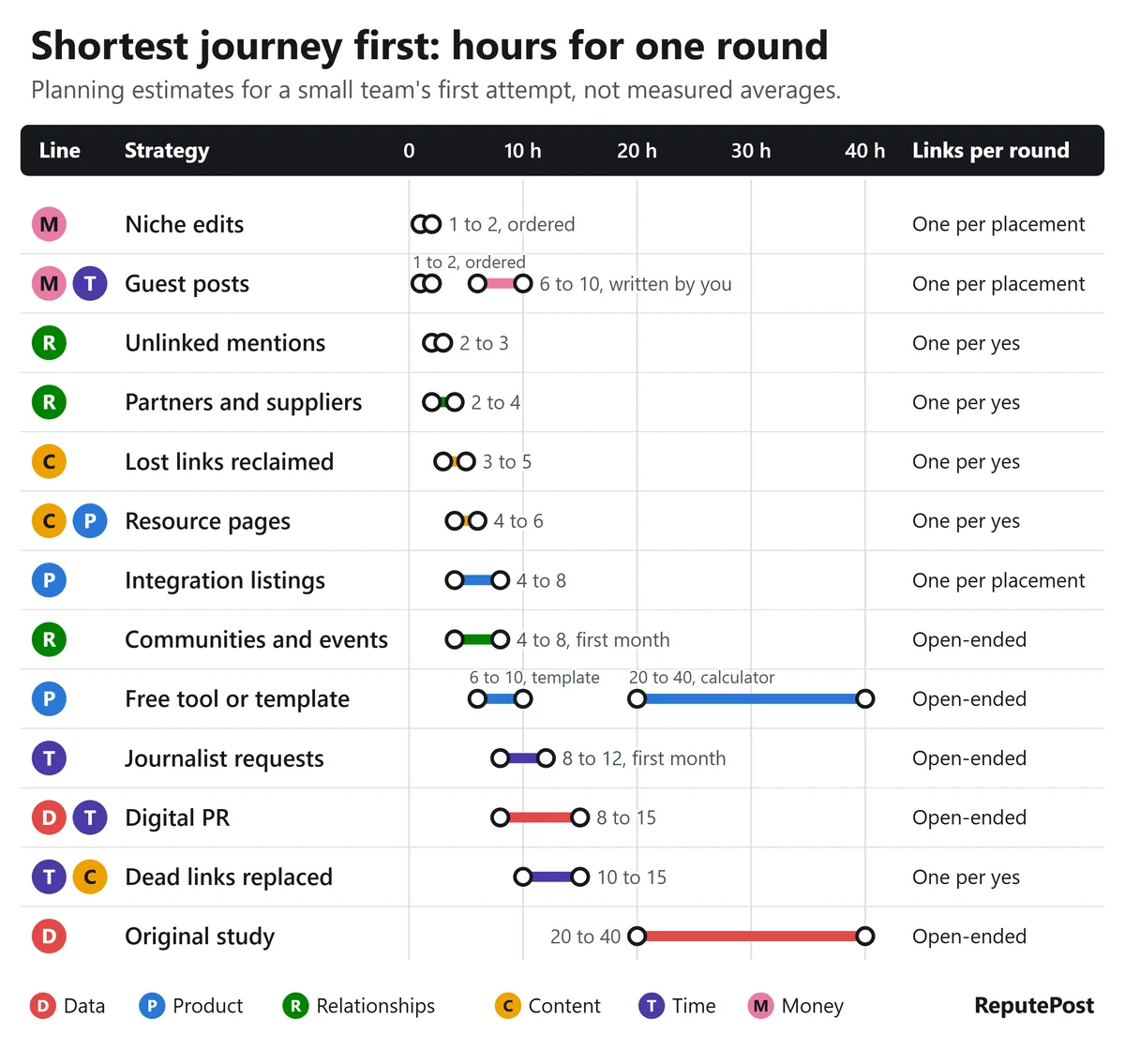
Hours for one round of each strategy, shortest first. A study can bring any number of links or none, while each request or order brings one at most. All hours are our planning estimates.
Advanced and creative link building strategies, with public examples
Advanced link building strategies in SEO are often basic ones repeated on a schedule. Creative link building strategies change what gets published. We opened every example here on 24 November 2026.
Two advanced link building techniques
Make the study a series. Backblaze, a storage company, has published the failure rates of its own hard drives since 2013 and updates them every quarter. The Q2 2026 snapshot covers 354,415 drives, and anyone can download the data. Wikipedia's page on drive failure cited three of its posts when we looked. A small site can do this with one number it already tracks, published in the same week each quarter.
Let people take it with them. Website Carbon is a free calculator for a page's emissions, and since 2020 it has offered a badge that site owners can put in their footer. If you copy the idea, keep the badge's link plain or nofollow, because Google lists keyword-rich, hidden or low-quality links in distributed widgets as link spam.
Two creative strategies
Publish what your industry keeps private. Buffer has shared its full list of salaries, and the formula behind them, since 2013. Your version might be delivery times, refund rates or what you pay for materials.
Own a date. Oxford University Press first put its word of the year to a public vote in 2022 and counted more than 340,000 votes; the 2026 shortlist was open for voting when we read the page. A plumber could name the most requested repair of the year, with the counts, every January.
Two advanced link building tips before you copy any of these: publish the method beside the result, and keep each new edition at the same URL so the links collect in one place.
Backlink strategy example: 12 weeks for one small site
Tidyvan.example is made up: three people selling a scheduling app to mobile cleaning firms. They have booking data, an app with two integrations, 24 blog posts, about five spare hours a week and a budget for two guest posts. Their SEO backlinks strategy puts the quick asks first, so replies come in while the study is being written.
| Week | Action | Owner | Hours |
|---|---|---|---|
| 1 | Export existing links, list errors and lost links, choose three pages that need links | Marketer | 4 |
| 2 | Fix redirects, email sites that dropped a link, set brand alerts | Marketer | 4 |
| 3 | Ask both integration partners and four suppliers for a listing | Founder | 4 |
| 4 | Pull a year of booking data and check nobody can be identified | Founder | 5 |
| 5 | Clean it, choose one question, test the headline | Marketer | 7 |
| 6 | Write the study and its method note | Marketer | 8 |
| 7 | Publish, then pitch ten trade and local reporters | Founder | 6 |
| 8 | Follow up once each and answer questions | Founder | 3 |
| 9 | Turn the study's main table into a free template | Marketer | 8 |
| 10 | Pitch the template to 25 resource pages | Marketer | 5 |
| 11 | Order two labelled guest posts that cite the study, check both live | Marketer | 4 |
| 12 | Review links, referral visits and hours per live link; keep or drop each line | Both | 4 |
| Total | 12 weeks | 62 |
That's 62 hours: 40 for the marketer, 18 for the founder and 4 shared. The data line takes 29 of them, far more than any other. That share is deliberate: nobody else has those bookings. The week 12 review needs a log with a date and a cost for every link. Drop the line with the most hours per live link. If one site nobody contacted has cited the study, run the data line again next quarter.
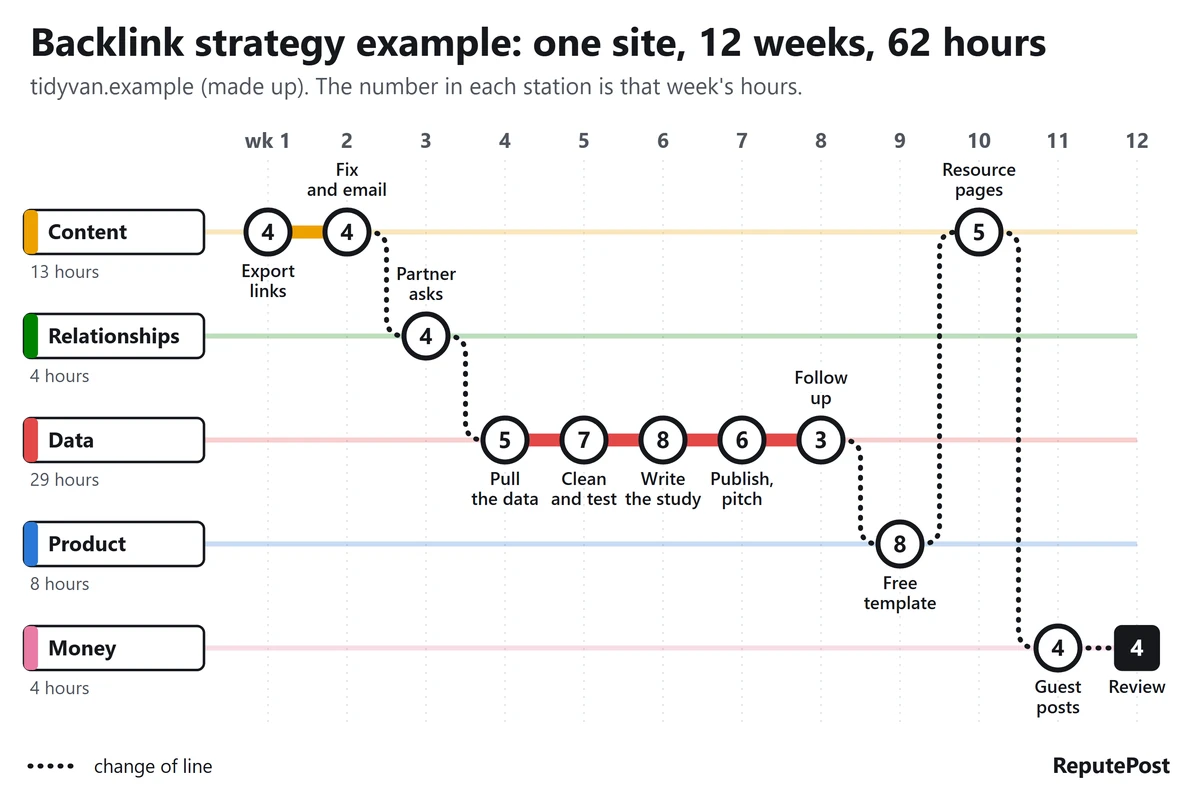
The same plan as a journey. Five of the 12 weeks stay on the data line; the dotted sections are changes of line, and week 12 is the review.
Link building strategies we'd retire in 2026
Several SEO link building tips still in circulation describe things Google's spam policies list as link spam. Link swaps at scale are there, and so are partner pages built only for cross-linking. Automated link programs are listed too, which rules out tiered link building run by software. The same list covers low-quality directory and bookmark links, optimized anchors in guest posts, forum posts and signatures, and free products sent out in exchange for a write-up with a link. If one of those is in your plan, take it out first.
We'd also drop three habits that break no rule. Mass pitching is one: half of the journalists in the Muck Rack survey are put off by anything that looks like a mass email. Machine-written answers to reporters are another, since they bring nothing the reporter couldn't have generated. The third is a monthly link quota with no say over which pages or sites, which pushes a team towards whatever is quickest to place. All three skip the question this page opened with. Pick something you have, make it worth pointing to, and the asking gets easier.
Related articles
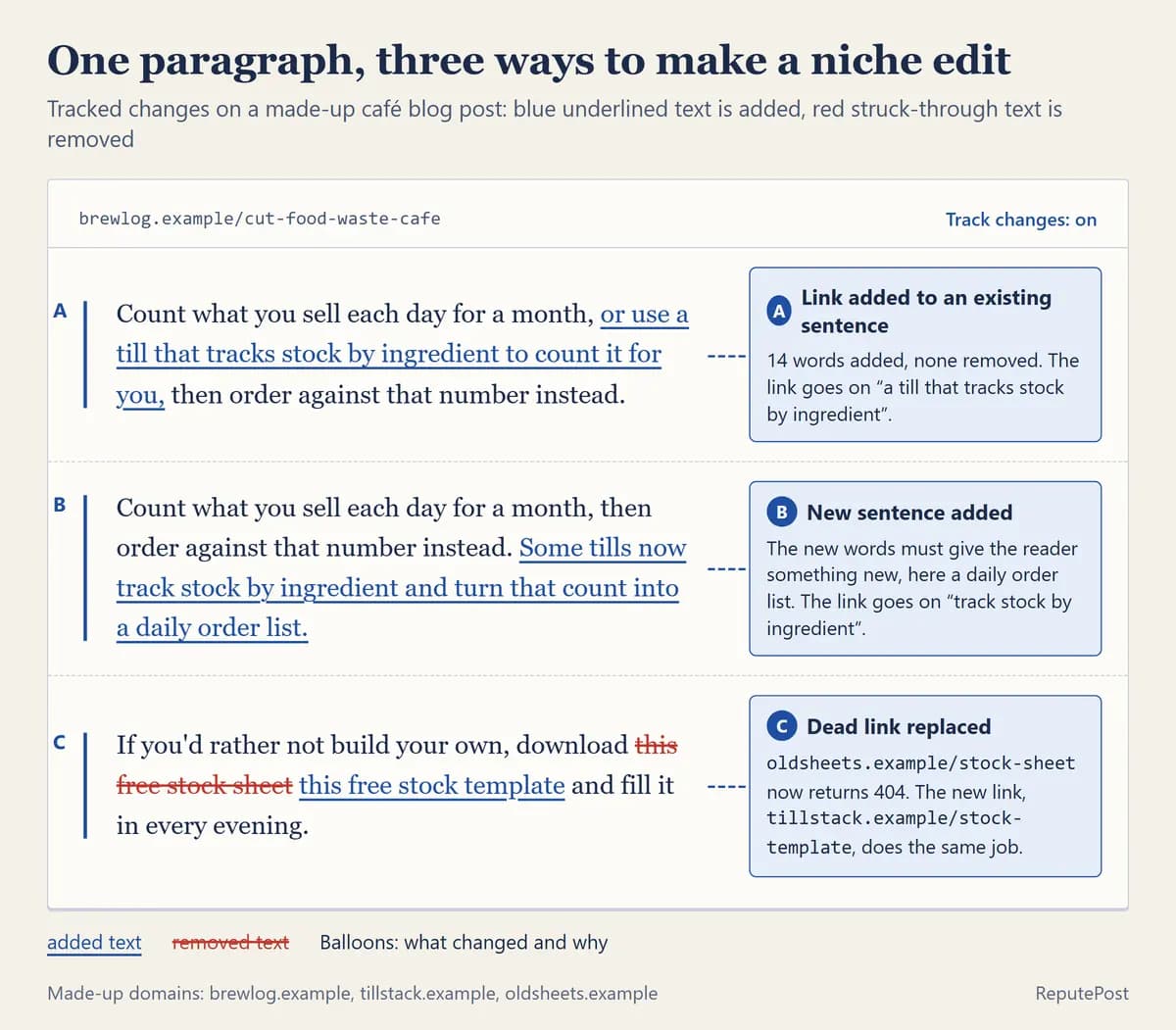
What Are Niche Edits? How Link Insertions Work in SEO
A niche edit adds your link to an article that already ranks. See one edit before and after, the six stages it goes through, how it compares with a guest post, and the page checks to run first.
15 min read
How Much Do Backlinks Cost? Prices by Link Type in 2026
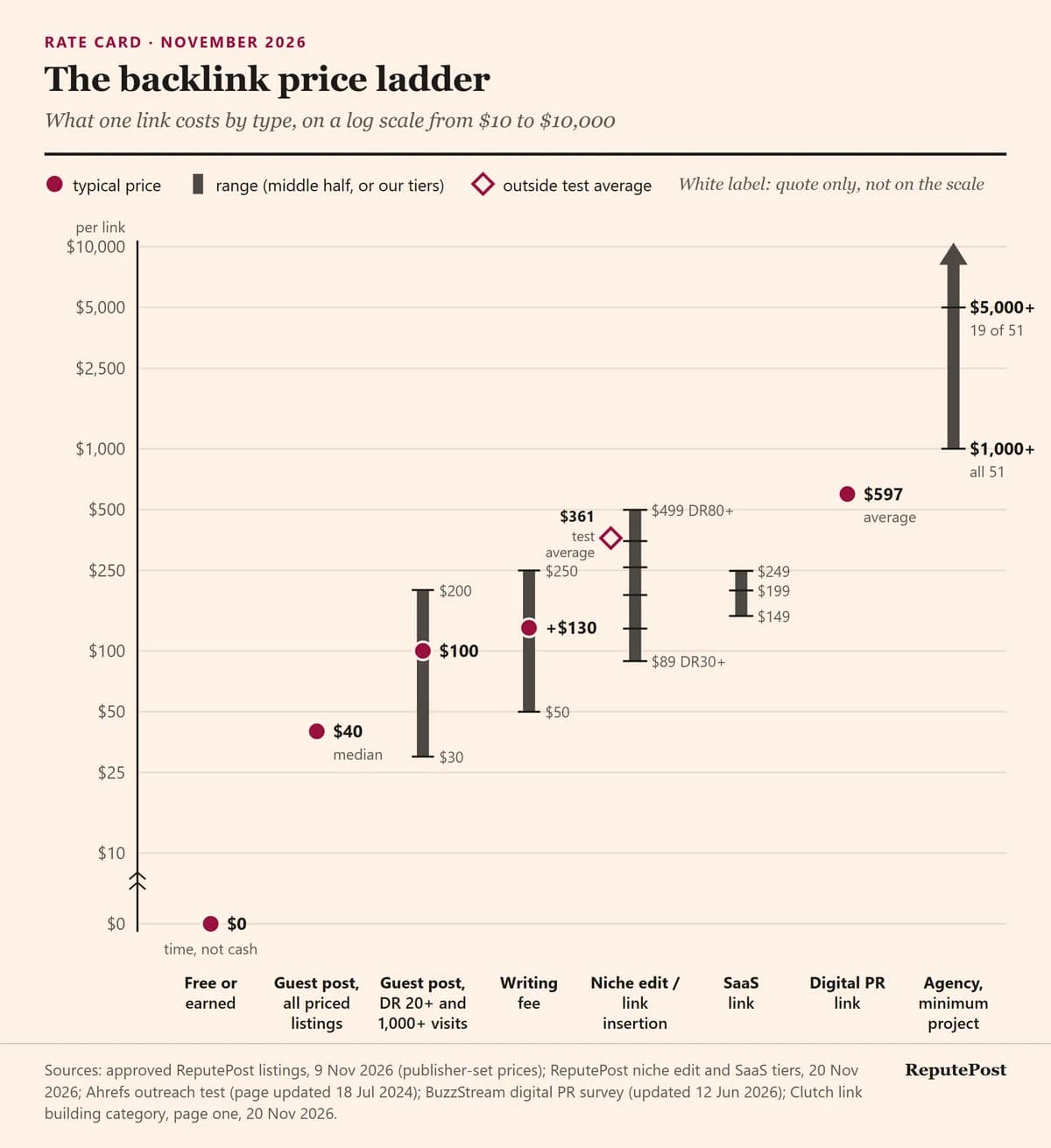
Most backlinks cost $0 to about $600 in November 2026. Our 15,812 listings show traffic, not DR, sets a guest post's price. Rate card, budgets and checks.
15 min read
How Many Backlinks Do I Need to Rank? Work Out Your Number
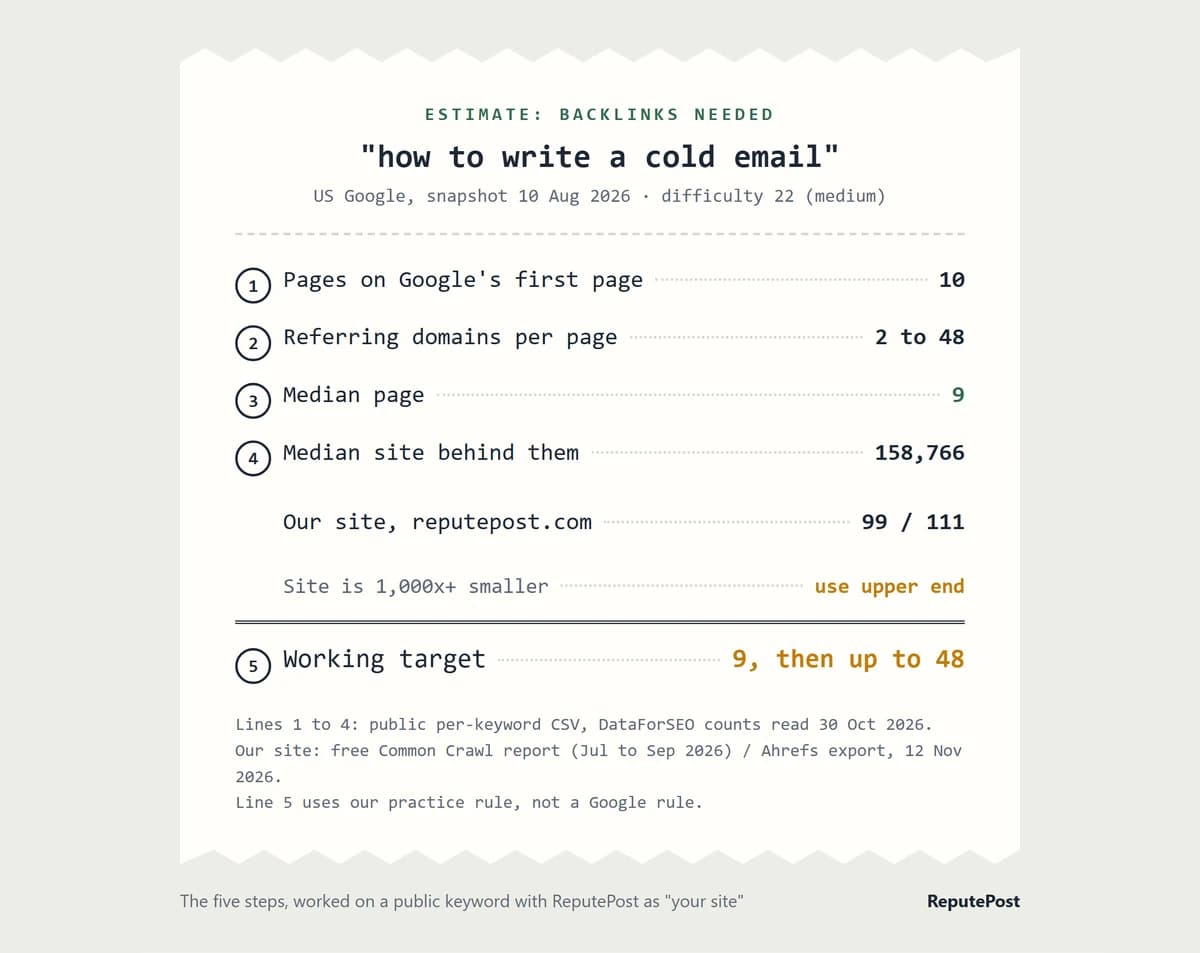
There is no fixed number. Count the referring domains of the pages ranking now, take the median, adjust for your site and set a safe pace. With a worked example and our own data.
16 min read