
Cheap Backlinks: What $10, $50 and $100 Really Buy
Ten $10 links, two $50 links or one $100 link? We sorted 15,812 approved listings by price to show what cheap backlinks really buy, the red flags in cheap offers, and how to buy safely.
Hamza Haroon
· 19 min read
Say you have $100 to spend on cheap backlinks this month. You could buy ten links at $10, two at $50 or one at $100. Which basket does the most for your site?
To answer with numbers instead of opinions, we sorted the guest post prices on all 15,812 approved ReputePost listings (9 November 2026) into price bands. Then we looked at what sits in each band: the sites' monthly organic traffic, their DR and their niche. 15,009 of those listings have a guest post price. These are the prices site owners set themselves, so they show the market before any marketplace or agency adds its fee.
Are cheap backlinks worth it? Here is what each basket gets, in brief:
- Ten $10 links mostly buy pages almost nobody visits. In every DR and traffic band in our data, at least three in four sites charge more than $10. At least two in three listings under $25 get fewer than 1,000 organic visitors a month.
- Two $50 links are the cheapest basket where sites with real traffic are common, as long as you write the articles. A third of the sites with DR 20+ and 1,000+ monthly visitors charge less than $50.
- One $100 link buys the middle of the market for those sites. But the price proves nothing on its own: 40% of listings priced $100 or more miss that bar.
For most sites, two $50 links on sites in your niche are the best use of $100. The sections below open each basket, then cover where cheaper links come from, the red flags in cheap offers, when cheap is fine, and a short test at the end.
Ten $10 links: what cheap backlinks at $10 and under look like
Our price bands start at "under $25", so for this basket we read that band alongside the cheapest quarter (the 25th percentile) of every DR and traffic group. Both tell the same story.
5,016 listings, a third of all priced listings, charge under $25 for a guest post. Only 1,087 of them (22%) have both a DR of 20 or more and at least 1,000 monthly organic visitors. At least 3,390 of the 5,016 get fewer than 1,000 organic visitors a month. (We can say "at least" because only 539 listings in the whole data set pair 1,000+ visitors with a DR under 20, so every other miss is a traffic miss.)
A true $10 price is rarer still. In every DR and traffic group in the data, the cheapest quarter of sites starts above $10: at $12 for DR 0 to 19, $13 for sites under 1,000 visitors and $15 for DR 20 to 29. So a $10 link comes from the very bottom of the market.
What a typical listing at this price looks like:
- Traffic: under 1,000 organic visitors a month. Sites at that level charge $30 at the median, and a quarter of them charge $13 or less.
- DR: anything, which is why DR misleads at this price. Sites with DR 80+ and 1,000+ visitors have a median price of $45, and a quarter charge $15 or less. Many are large open platforms where anyone can publish under a contributor account, so your link sits on a user page with little traffic of its own.
- Niche: broad, crowded topics. Across all listings, the lowest medians are movies ($18), internet, computers and agriculture ($20 each), literature ($22) and humor ($25).
- Writing: yours. The median writing fee across all listings is $60, six times the price of the link.
Ten links like these add ten referring domains, and a count is what a typical cheap backlink service sells. What they rarely add is a page that Google sends readers to. If you buy at this level, buy one or two budget backlinks in your exact topic rather than ten across anything.
Two $50 links: what about $25 to $50 buys
Move up to $25 to $50 and the shelf starts to change. 3,003 listings (20% of priced listings) sit in the $25 to $49 band, and 28% of them clear both DR 20 and 1,000 monthly visitors. One band higher, at $50 to $99, the share is 42%, the biggest jump between any two neighbouring price bands.
Seen from the other side, the basket looks better still. 1,934 sites with DR 20+ and 1,000+ visitors, 34% of that group, charge under $50. In every DR band from 20 to 79, the cheapest quarter of sites with 1,000+ visitors charges $40 or less. It holds further up too: among DR 20 to 79 sites with 5,000 to 19,999 visitors, a quarter charge $35 or less. So $50 doesn't only buy the bottom of the market. It buys the cheaper end of almost every band of real sites.
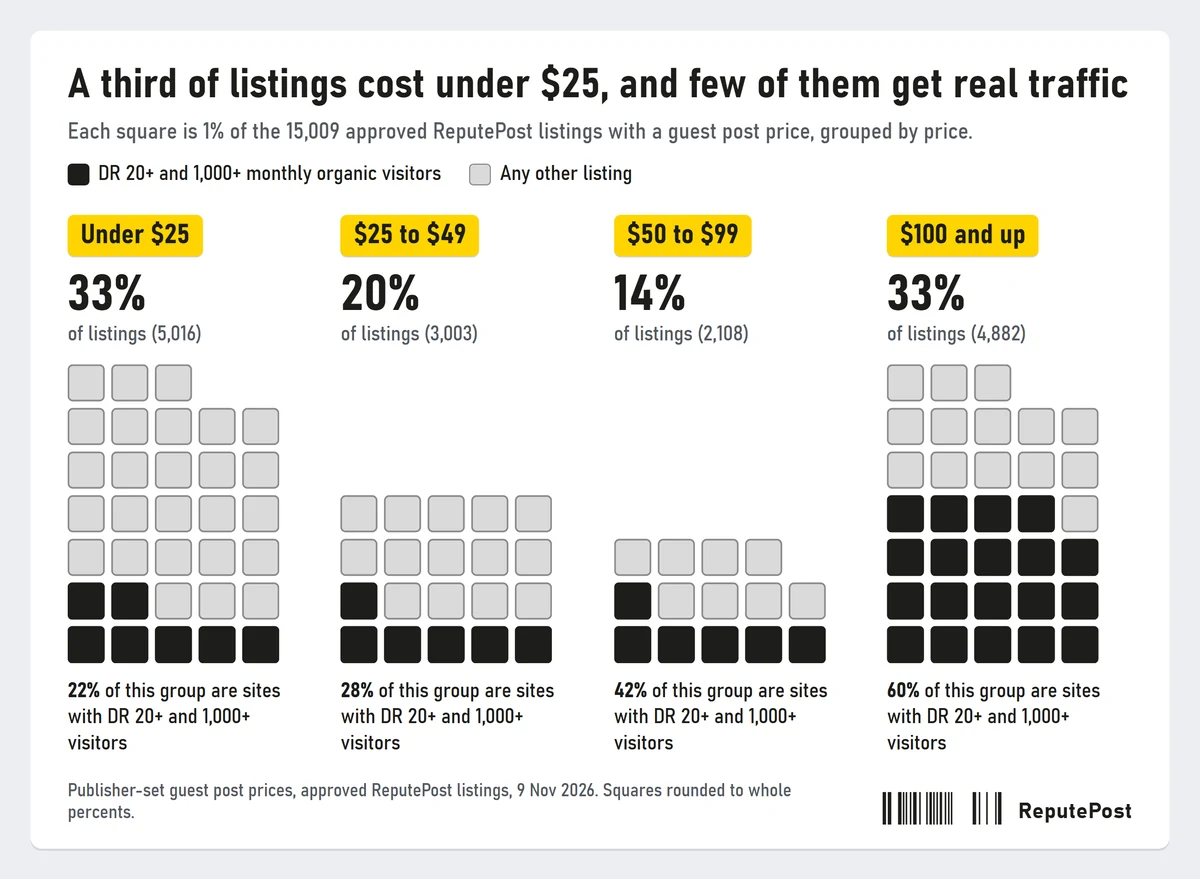
Each square is 1% of the 15,009 approved ReputePost listings with a guest post price (publisher-set prices, 9 November 2026). Black squares are sites with DR 20+ and 1,000+ monthly organic visitors: 22% of the under-$25 group, 60% of the $100-and-up group.
What a typical listing at this price looks like:
- Traffic: 1,000 to 4,999 visitors a month. The median there is $90 (DR 20 to 79), and a quarter of sites charge $30 or less.
- DR: 20 to 79. Inside that range the median for sites with 1,000+ visitors only moves between $90 and $119, so at this price choose on traffic and topic, not on DR.
- Niche: crowded niches give you the most choice. Among sites with DR 20+ and 1,000+ visitors, the medians are $59 for web development, $60 for education, $75 for technology and $80 for health. In those four, the cheapest quarter starts between $17 and $30. In cars, pets and sports, even the cheapest quarter starts at $70 or more.
- Writing: still yours. When the site owner writes, the median fee on these sites is $130, more than the placement.
This is the basket we'd pick for most sites: two real sites in your topic, chosen on traffic, each carrying an article you wrote. If you want to get backlinks cheap without buying junk, start here. It's also our answer to the cheapest legit way to buy guest posts. The catch is time. Writing two articles good enough for a site with real readers is work, and a low price is no excuse to send a thin one.
One $100 link: what $100 and up buys
$100 is the median price for sites with DR 20+ and 1,000+ monthly visitors, so a $100 budget can buy into half of that group. It's also the median for DR 20 to 79 sites with 5,000 to 19,999 visitors. Sites with 20,000 to 99,999 visitors have a median of $130.
4,882 listings, about a third of priced listings, charge $100 or more, and 60% of them clear DR 20 and 1,000 visitors. That's the best ratio of the three baskets. It also means 40% of them, 1,947 listings, don't, and at least 1,408 get fewer than 1,000 organic visitors a month while asking $100 or more. A higher price narrows the field. It doesn't vet it for you.
What a typical listing at this price looks like:
- Traffic: 5,000 to 19,999 visitors a month at the median price. Some bigger sites fit too: a quarter of DR 20 to 79 sites with 20,000 to 99,999 visitors charge $41 or less.
- DR: 40 to 79 comes into reach. For sites with 1,000+ visitors, the medians run from $100 (DR 50 to 59) to $119 (DR 40 to 49).
- Niche: this is where niche matters most. In cars ($195), pets ($175), sports ($160), politics ($150), news ($145) and finance ($140), $100 is still below the median. In technology or education it buys from the top half.
- Writing: separate again. With the site owner writing, the median total on these sites is about $245.
One $100 link is worth it in three cases: your niche is expensive, the site has 5,000+ monthly visitors in your topic, or the page you want to rank needs one strong link more than several small ones. It isn't worth it just because the price feels safer. Price and traffic are not the same number.
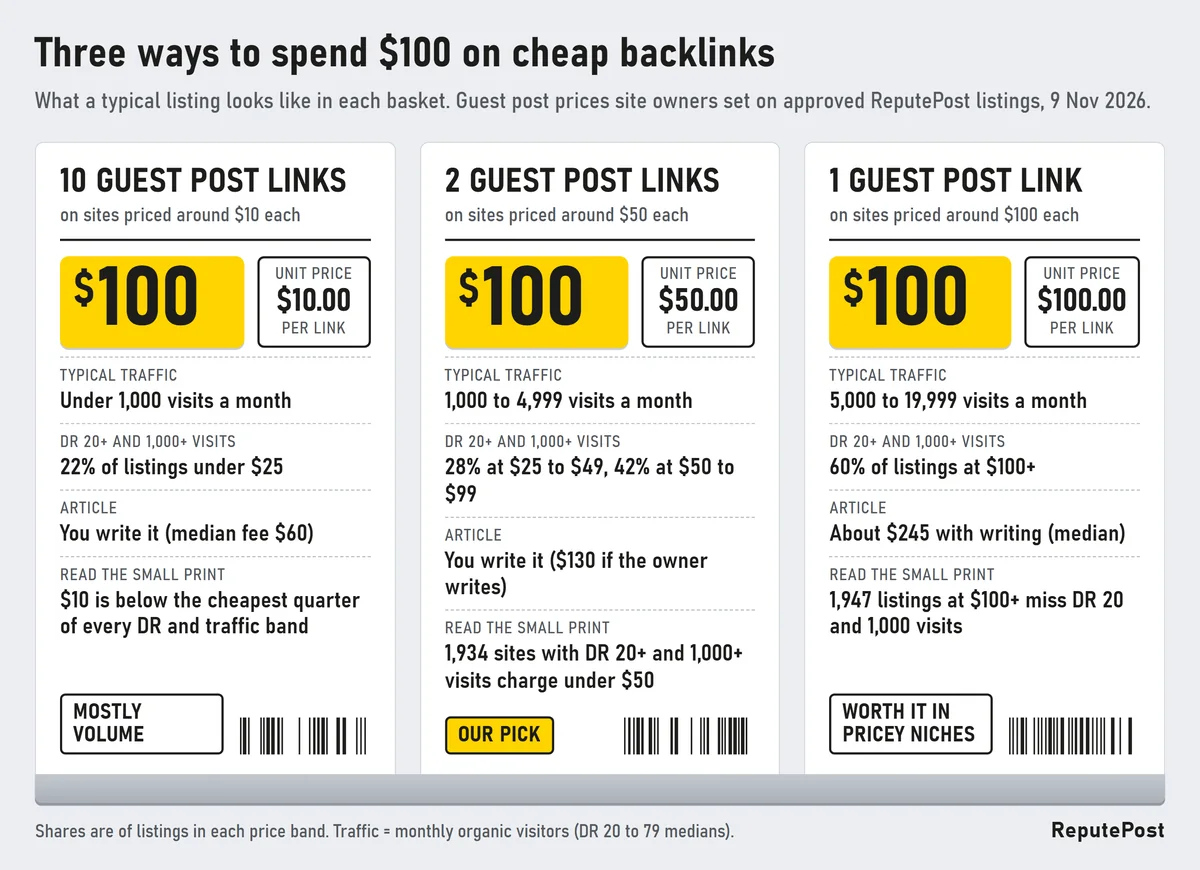
The three $100 baskets as shelf labels. Typical traffic, the share of sites with DR 20+ and 1,000+ monthly visitors, and the writing cost come from the guest post prices site owners set on approved ReputePost listings (9 November 2026).
Where cheap backlinks come from, and what they really pass
A marketplace listing is only one source of cheap SEO backlinks. Most people who buy backlinks cheap get them from one of five places, and this month we checked four of them first-hand. Keep one rule in mind while reading. Google treats nofollow, ugc and sponsored as hints: a link carrying one of them may still be used, but you can't count on it.
1. Pages you make yourself. Free blogs, site builders and profiles. When we checked 34 web 2.0 platforms in November 2026, 20 left the links inside posts dofollow. That's worth knowing before you buy web 2.0 backlinks cheap from someone else: you can make the same pages yourself in an afternoon. They give a new site a base and a brand footprint, but the page has no readers or links of its own, so it passes little.
2. Forums and blog comments. On 14 of the 21 forums where member links showed in our November check, no ordinary member's link was a plain followed link. Every commenter link we read, on 15 blogs, carried nofollow. These links can bring visits from people in the thread. For rankings they do close to nothing.
3. Directories. We logged 14 of our own directory profiles on 20 November: 11 were live, 3 had a followed link, 8 a nofollow link and 3 no link at all. Map listings and review sites matter for trust and local search. Packages that submit you to hundreds of directories are a different thing: Google's spam policies list "low-quality directory or bookmark site links" as link spam.
4. Bulk packages. One package page in Google's top results for "cheap backlinks" on 20 November sold more than 750 links for $12 and 50,000 links for $125, under two cents a link. At that price no one is choosing sites for your topic, and the same policy names "using automated programs or services to create links to your site".
5. Cheap guest posts on real sites. The three baskets above. Of the five, it's the only source where you can see the site, its traffic and the kind of page your link will sit on before you pay. A cheap guest post on a small site in your topic can do more than any number of links from the other four. So where can you buy cheap backlinks that still work? From real sites in your topic whose traffic you can see before you pay.
Red flags in cheap backlink offers
Many cheap backlink offers arrive as cold emails. The one below is made up, but each line is the kind of thing link sellers write, and five of them should stop you.
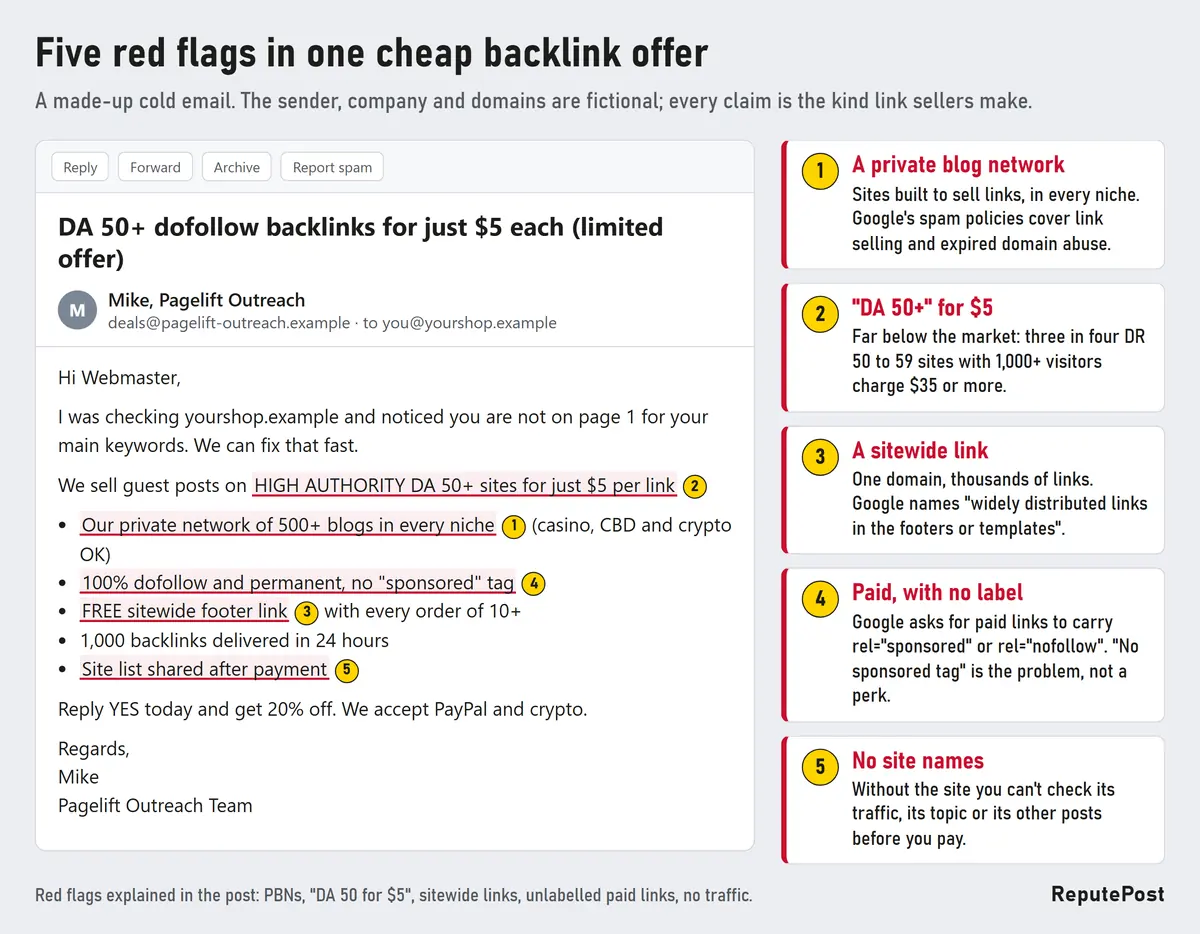
A made-up cold email with the five red flags marked. The sender, company and domains are fictional; each numbered note matches a red flag below.
1. A private blog network behind the offer
A private blog network (PBN) is a group of sites built or bought, often on expired domains, mainly to sell links. Google's policies cover it twice: "expired domain abuse", where an expired domain "is purchased and repurposed primarily to manipulate search rankings", and "creating low-value content primarily for the purposes of manipulating linking and ranking signals".
The signs: nearly every post is sponsored, topics jump from casino to pets to crypto, there are no real authors, traffic is close to zero and the seller won't name a site before you pay. Offers to buy PBN backlinks cheap are this, with the label left on. Cheap casino links deserve the closest look of all, because many real site owners refuse casino content or charge more for it.
2. "DA 50 for $5"
Most offers to buy high DA backlinks cheap lean on a third-party score. DA (from Moz) and DR (from Ahrefs) are both built from links. Moz says DA "isn't a direct ranking factor used by Google", and Ahrefs says DR "doesn't take into account any other variables like link spam, traffic, domain age". So a network of sites linking to each other can hold a high score with no readers at all, which is also why a score built that way says nothing about what actually moves DA and DR on a real site.
Then check the price. Among sites with DR 50 to 59 and 1,000+ visitors, three in four charge $35 or more. A "DA 50" link for $5 is priced like a site nobody visits, because it usually is one.
Older labels work the same way. Google stopped feeding toolbar PageRank data on 15 April 2016, so anyone asking you to buy cheap high PR backlinks today is quoting a number no one can check. And if you're tempted to buy edu backlinks cheap, ask for the exact page first: a student profile or an open comment form on a university domain is not a link from the university.
3. Sitewide links
A footer, sidebar or blogroll link appears on every page of a site, so backlink tools may count it hundreds or thousands of times, all from one referring domain. Google's spam policies name "widely distributed links in the footers or templates of various sites". A sitewide "bonus" in a cheap package adds risk, not value.
4. Paid links with no label
Google's spam policies class "buying or selling links for ranking purposes" as link spam, and that includes "exchanging money for links, or posts that contain links". The same section says paid links don't break the policy when they carry rel="sponsored" or rel="nofollow". The price doesn't change that: a paid, followed link is the same thing to Google at $5 or at $500.
So when an offer to buy dofollow backlinks cheap promises "100% dofollow, permanent, no sponsored tag", that cheap dofollow backlink is the exact pattern the policy describes. Ask any site how it marks paid posts, and get the answer in writing before you order.
5. No traffic, or traffic that's falling
DR counts links. Traffic shows whether Google sends anyone to the site. At the cheap end, low traffic is the most common gap: 58% of the approved listings with a price get fewer than 1,000 organic visitors a month, so filter by traffic before you look at anything else. Look at the organic traffic trend for the last 6 to 12 months in Ahrefs or Semrush.
A site that lost half its traffic this year is worth less than its listing says, and an offer that shows DR but never mentions traffic is often leaving it out for a reason.
When a cheap backlink is fine
Cheap isn't the problem. A cheap backlink on the wrong site is. These are the cases where a low price is fine, and the ones where it isn't.
| Cheap is fine when | Pay more, or skip, when |
|---|---|
| The link is for visitors, not rankings: a thread, newsletter or small blog your buyers actually read | You need the link to move a page for a competitive keyword |
| Your niche is crowded, so supply keeps prices low (web development, education, technology) | Your niche is expensive (cars, pets, sports, finance), where a cheap site is more often a weak one |
| The site is small but exactly on topic, such as a local blog with a few hundred readers in your town | The site is big but off topic, or publishes any topic for anyone who pays |
| You're building a new site's base: brand profiles, map listings, review sites | The topic is health, money or law, where the linking site's reputation is part of what the link says about you |
| You're testing a site with one small order before a bigger one | You need the article written, which at the median costs more than a cheap placement |
Affordable link building packages and services: what a low price should still include
Search for affordable link building or cheap link building and you'll find three kinds of offer. They show you very different amounts before you pay. We sell two of them, so we say where ours fit.
Per-link marketplaces
You pick each site from a list showing its metrics and price, then order a post or a link on that exact site. It's the cheapest way per link and gives you the most control, and it takes the most of your time. If you're comparing the cheapest guest post marketplaces, compare what each one shows before you pay, not just the lowest number. You can browse sites on ReputePost from $6.50: every site is checked by a person before it's listed, and its traffic sits next to its price.
Video (1:19): finding a site by DR, traffic, niche and language, then approving the post before the publisher is paid.
Fixed-price packages
A set number of links at set DR tiers for a set price, usually without naming the sites in advance. They're easy to budget for. Check that each tier also promises a traffic minimum, because DR alone is the easiest number to inflate. ReputePost's niche edit service works this way: from $89 for a link added to an existing article on a DR30+ site with 1,000+ monthly visitors, writing included, delivered in 2 to 14 days, with a free replacement if the link is removed.
Monthly link building services
An agency or freelancer runs outreach for a monthly fee. At the low end, a smaller fee has to mean fewer links, smaller sites or less outreach, so ask which one it is. Before you sign any of the affordable link building services or cheap link building services on your shortlist, ask for last month's list of sites and two live examples, and hold them to the list below.
Whatever you pay, a low price should still get you:
- The site named before you pay, or at least its niche, DR and traffic.
- Organic traffic that's recent and shown by a tool you can check.
- A link in the body of a page Google can index, near words about your topic.
- How the link will be marked (followed, nofollow or sponsored), in writing.
- The live URL and the date, so you can check it yourself.
- A replacement or a refund if the link disappears.
How to buy cheap backlinks without getting burned
Run every cheap offer through these eight checks. Most take a minute or two per site.
- Start from your page, not the price. Decide which page the link is for and what a linking site should be about. Then score how relevant a site is before you look at its numbers.
- Set your price from traffic. For sites with DR 20 to 79, the median publisher price is $30 under 1,000 monthly visitors, $90 at 1,000 to 4,999 and $100 at 5,000 to 19,999. Far above that, ask why. Far below it, ask what's wrong. The full breakdown by traffic, DR and niche has the rest.
- Get the exact site and a recent post. No name, no order. Ask for the URL of a post published in the last month.
- Check the traffic trend. Look at 12 months of organic traffic, not one number. Flat or growing is fine; a cliff isn't.
- Read the last ten posts. If most are sponsored and the topics are all over the place, the site sells links more than it serves readers.
- Check that its posts get indexed. Search Google for an older sponsored post on the site (site: plus its URL). If it doesn't show, yours probably won't either.
- Agree the link details. How it will be marked, where in the article it goes, and an anchor that reads naturally: your brand or plain words, not your exact keyword every time.
- Check it after it's live. Open the page, check the link and its rel value, and check again after 30 and 90 days.
Spend a small budget on a few links that pass all eight, not many that pass none. That's the honest way to buy quality backlinks cheap. If you buy SEO backlinks cheap any other way, you often pay twice: once for the link, and again to clean it up.
Spot the problem: three cheap backlink offers
Here are three made-up offers for the owner of a home-improvement blog with $100 to spend. Which one would you buy? The answers are below them.
Offer A: 20 "DA 50+" links for $49
From an email by rankboost.example: 20 dofollow guest posts on "high authority DA 50+ sites", plus a sitewide footer link as a bonus. Live in 48 hours. The site list comes after payment.
Offer B: one guest post for $45
A marketplace listing for homebench.example, a home-improvement blog: DR 31, about 2,400 organic visitors a month, steady for the past year. You send a 1,000-word article with one link in the body. The listing states how the link is marked and offers a replacement if it's removed. Two of its last ten posts are sponsored.
Offer C: one guest post for $120
metro-wire.example, a general news-style site: DR 78, about 300 organic visitors a month, down from about 9,000 a year ago. It publishes around 40 posts a week on casino, crypto and loans, and promises "permanent dofollow, no sponsored tag".
Answers
Buy B. It's in your topic, its traffic is steady, and you can check all of it before you pay. Its $45 price sits inside the normal range for its traffic: the middle half of DR 20 to 79 sites with 1,000 to 4,999 visitors charge $30 to $200.
Skip A. It trips four red flags at once: a "DA 50+" claim at a fraction of what three in four real DR 50 to 59 sites charge, a sitewide link, delivery at a speed only a network can manage, and no site names until you've paid.
Skip C. A DR 78 score with 300 visitors and a feed of casino and loan posts belongs to a site that sells links more than it serves readers, and "no sponsored tag" is the unlabelled paid link from red flag 4. It costs more than B and is worth far less.
Related articles
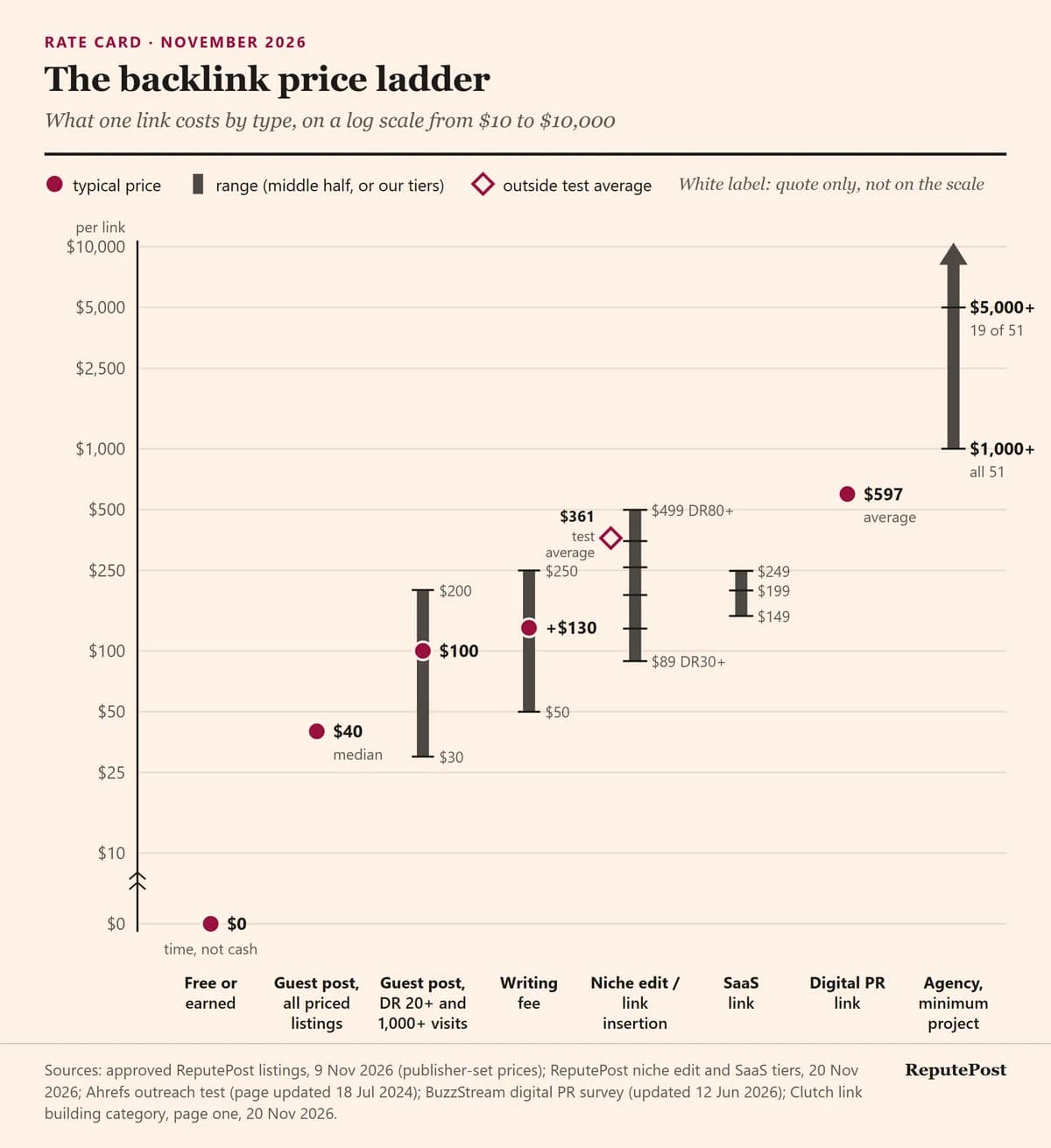
How Much Do Backlinks Cost? Prices by Link Type in 2026
Most backlinks cost $0 to about $600 in November 2026. Our 15,812 listings show traffic, not DR, sets a guest post's price. Rate card, budgets and checks.
15 min read
How to Find Backlinks to Your Website for Free
Five free ways to find backlinks to your website, with real Search Console and Bing screenshots: what each tool shows, its limits, how to check a link you find, and when to disavow (rarely).
15 min read
How to Sell Backlinks and Make $4K+ a Month: A Guide for Website Owners
What you can sell, what backlinks really sell for (publisher prices by traffic and DR), what $4,000 a month takes, the checks your site must pass, how to sell on ReputePost step by step and other ways to find buyers.
13 min read