
How to Increase Domain Authority (DA and DR)
Domain authority rises when more strong sites link to you. What moves Moz DA and Ahrefs DR (and what doesn't), where 5,757 real sites sit on the DR scale, a 90-day plan and a new site's climb to DR 40.
Hamza Haroon
Updated · 14 min read
The short answer to how to increase domain authority is links: more websites linking to yours, and above all websites with strong link profiles of their own. Moz's Domain Authority (DA, 1 to 100) and Ahrefs' Domain Rating (DR, 0 to 100) are both calculated from links. According to Moz, DA comes from its link index, through a machine learning model that weighs linking root domains and the quality of those links. Ahrefs describes DR as the strength of a site's backlink profile: the sites linking to you, their own DR and how many other sites each of them links to. Google uses neither score. Most advice on how to improve domain authority mixes this link work with site fixes the scores never see, so here is the split.
Moves DA and DR | Doesn't move them directly |
|---|---|
A website linking to you for the first time (a new referring domain) | Extra links from a site that already links to you (Ahrefs counts referring domains, not backlinks) |
Links from sites with strong link profiles of their own | On-page SEO: keywords, titles, meta tags, schema markup |
Links from sites that link out to few other domains | Page speed, Core Web Vitals, HTTPS, mobile layout |
Losing sites that linked to you (down) | Domain age |
Other sites gaining links faster than you (down, because both scores are relative) | Organic traffic, social shares and likes |
The tool finding new links, or updating its index or model | Nofollow, sponsored and UGC links (for Ahrefs DR) |
The right-hand column still matters in Google. Content, speed and on-page work decide whether a page deserves to rank once the links arrive. They just aren't inputs to either score, so they only lift DA or DR when they lead other sites to link to you. Links are the only way to build domain authority in either tool.
What is a good domain authority?
A good domain authority is one that is level with, or above, the sites ranking for the searches you want. There is no fixed number. Moz says a DA of 30 "might be exceptional in one industry but low in another". Ahrefs says a DR is good if it's "higher than or comparable to similar sites". The same answer applies if you're asking what is a good domain rating.
To put real numbers on the scale, we looked at 5,757 sites with DR 20 or higher and at least 1,000 monthly organic visitors (approved ReputePost listings, 9 Nov 2026). Each is a working site with search traffic, and their DR spans the whole range.
1,713 of them (30%) have a DR between 20 and 39 and still get 1,000+ organic visitors a month.
The biggest single band is DR 50 to 59, with 1,291 sites (22%). Just over half (3,106, or 54%) are DR 50 or higher.
Only 399 (7%) reach DR 80 or more.
Nothing in this group sits below DR 20, because DR 20 is the minimum to pass review. So read the chart below as where sites with real traffic sit, not as what every website scores. It does show that traffic doesn't wait for a high number: nearly a third of these sites earn it in the 20s and 30s. A higher domain authority makes ranking easier mainly because it reflects more and better links, and the sites you compete with set the bar.
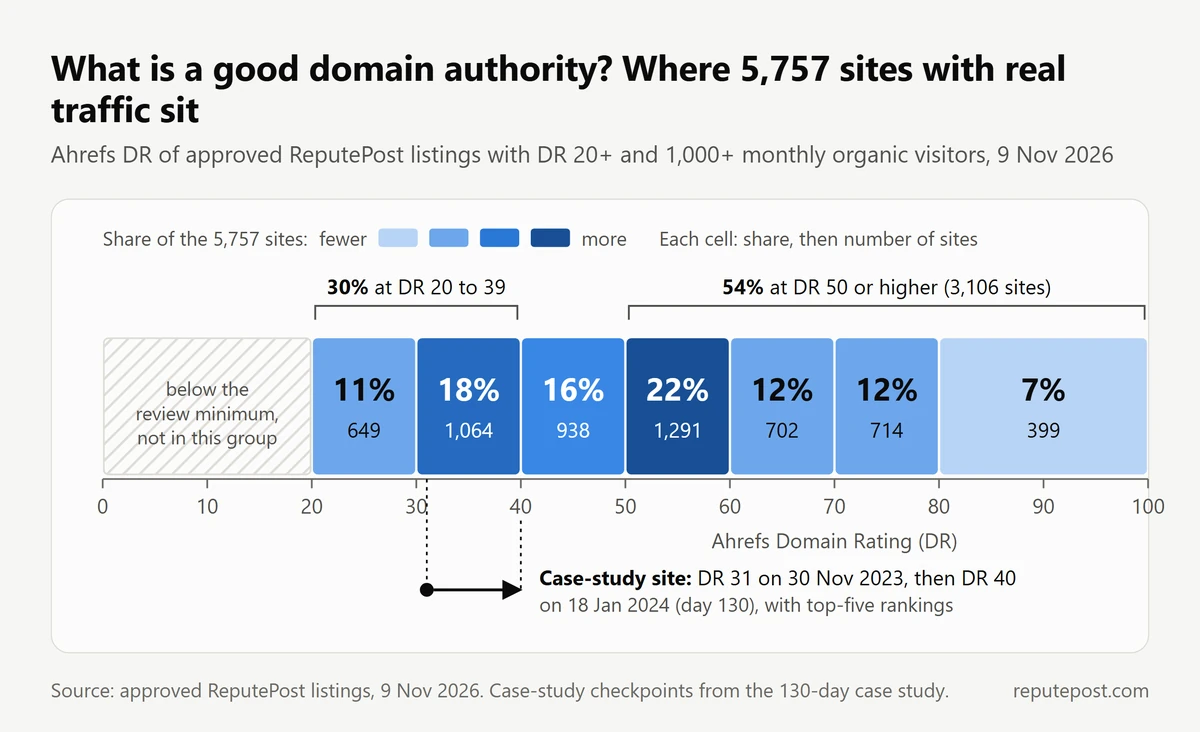
Where 5,757 approved ReputePost listings with DR 20+ and 1,000+ monthly organic visitors sit on the Ahrefs DR scale, 9 Nov 2026. Darker cells hold more sites.
To find your own bar, search your three to five main keywords. Check the domains on page one in a free tool such as Moz's Domain Authority checker or Ahrefs' Website Authority Checker. Leave out giants like Wikipedia, Reddit and big news sites, and take the middle of what's left. That is your target, not 100. In the case study below, DR 40 was enough for a new site's main pages to reach the top five in a crowded niche.
How to increase domain authority: a 90-day plan
This plan works for DA and DR alike, because both respond to new linking sites with strong link profiles. Ninety days is enough to see whether it's working: in the case study below, a brand-new domain reached DR 31 in under three months. If you're working out how to increase your domain authority without wasting the first month, the order matters more than the tactics.
Days 1 to 14: benchmark against the sites above you
Write down your DA, DR and number of referring domains, with the date. Use the same tools every time, because the numbers don't match across tools.
Do the same for the five to ten sites ranking for your main keywords, and mark the middle of their range as your target.
Run a link gap report (Link Intersect in Ahrefs, Backlink Gap in Semrush) to list the sites that link to two or more of those competitors but not to you. That list is your outreach plan.
Pick the pages you want links to, and make sure each one is worth linking to. Speed and content don't change the score, but they decide whether a link turns into rankings.
Days 15 to 45: collect the links you're already owed
The quickest new referring domains are the ones that should already be there.
Unlinked mentions. Search for your brand name and ask the sites that mention you without a link to add one.
Links to dead pages. Find backlinks that point to pages you've deleted, then redirect those URLs to the closest live page or ask the linking site to update the link.
People you already work with. Suppliers, partners, clients, associations and events often list the businesses they work with.
One asset worth linking to. Original data, a free tool or a template gives other sites a reason to cite you, which is the only way content raises DA.
Days 46 to 90: contextual links on sites with real readers
Now work through the gap list. Guest posts and niche edits on sites that already link to your competitors were the core of the case study below. Before you agree to any placement, check three things about the host site:
Its organic traffic is steady or rising, not falling.
Its topic is close to yours, and the article your link sits in would interest your readers too.
It doesn't link out to huge numbers of other sites. Ahrefs splits each site's rating equally among the domains it links to. A modest site with few outbound links can do more for your DR than a famous one that links to everyone.
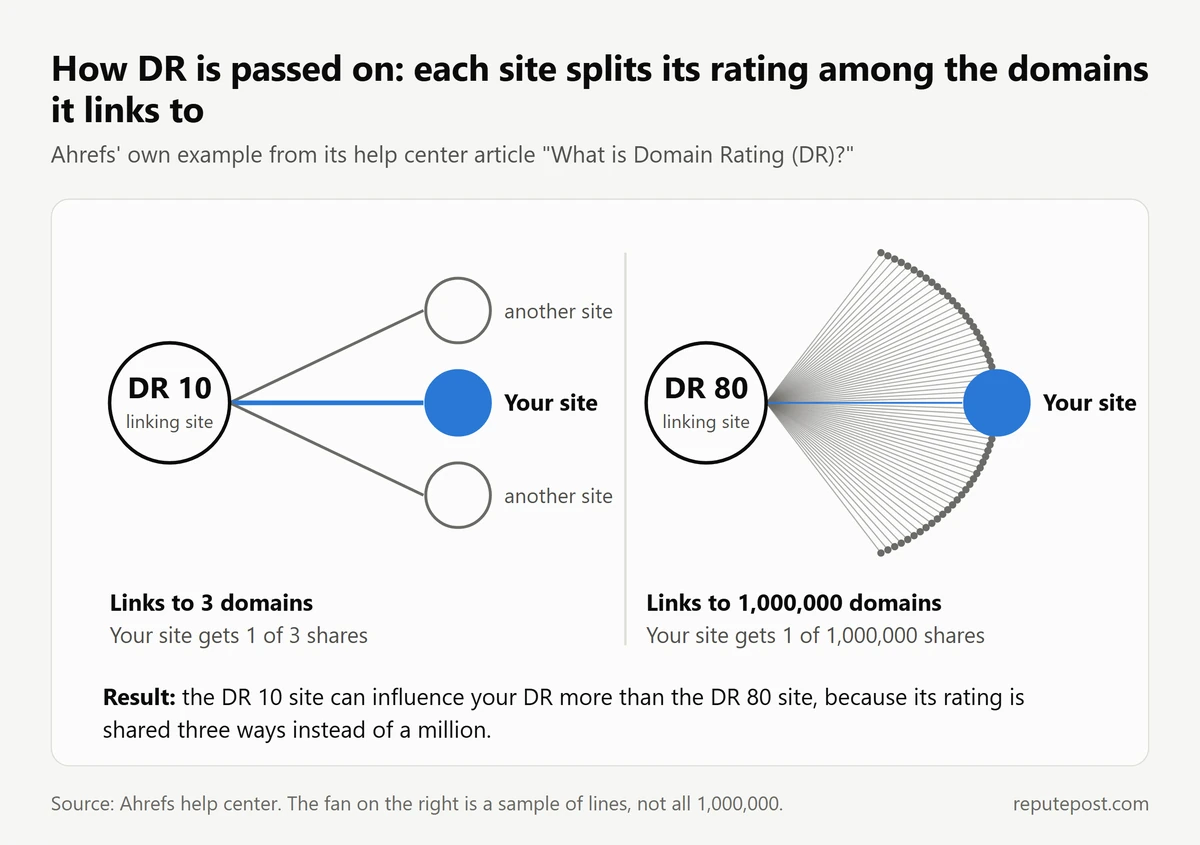
Ahrefs' own example of how DR is passed on: each linking site's rating is split equally among all the domains it links to.
If you pay for some of these placements, pay for the host site's numbers, not a promise about yours: nobody can guarantee what your DR will be. ReputePost's niche edit service is priced that way, by the DR of the vetted site the link goes on, from $89 at DR30+ to $499 at DR80+. Space the links out and keep roughly to the pace of the sites above you, which the referring domains graph in Ahrefs' Site Explorer shows for any site.
Day 90: measure in the right order
Compare against your day-one numbers in this order: referring domains (what you did), then DA and DR (how the tools scored it), then rankings and clicks (why you did it). If referring domains rose and DR barely moved, look at the linking sites: low DR, lots of outbound links or nofollow links would explain it. If DR fell while you gained links, check whether you lost any, and remember that other sites gaining links push everyone else down the scale.
A real example: from no links to DR 40 in 130 days
Here is the plan in practice, on a client site we built links for from its launch on 10 September 2023 (the site isn't named). It started in a crowded niche with no backlinks, no rankings and no traffic.
September: 10 to 15 profile and review listings plus social profiles, left as nofollow or UGC. They helped the site get crawled and indexed; they weren't there to raise DR.
From late September: guest posts on 15 sites that already linked to competitors.
October and November: 41 niche edits in existing, indexed articles. On 30 November the site's DR was 31, and Google sent it about 5 clicks a day.
1 to 15 December: 12 editorial placements on established sites (15 paid for, 12 went live). Clicks from Google jumped around 11 December.
18 January 2024, day 130: DR 40, 76 referring domains and 212 backlinks. The main pages ranked in the top five, and by late January the site was getting about 2,000 clicks a day.
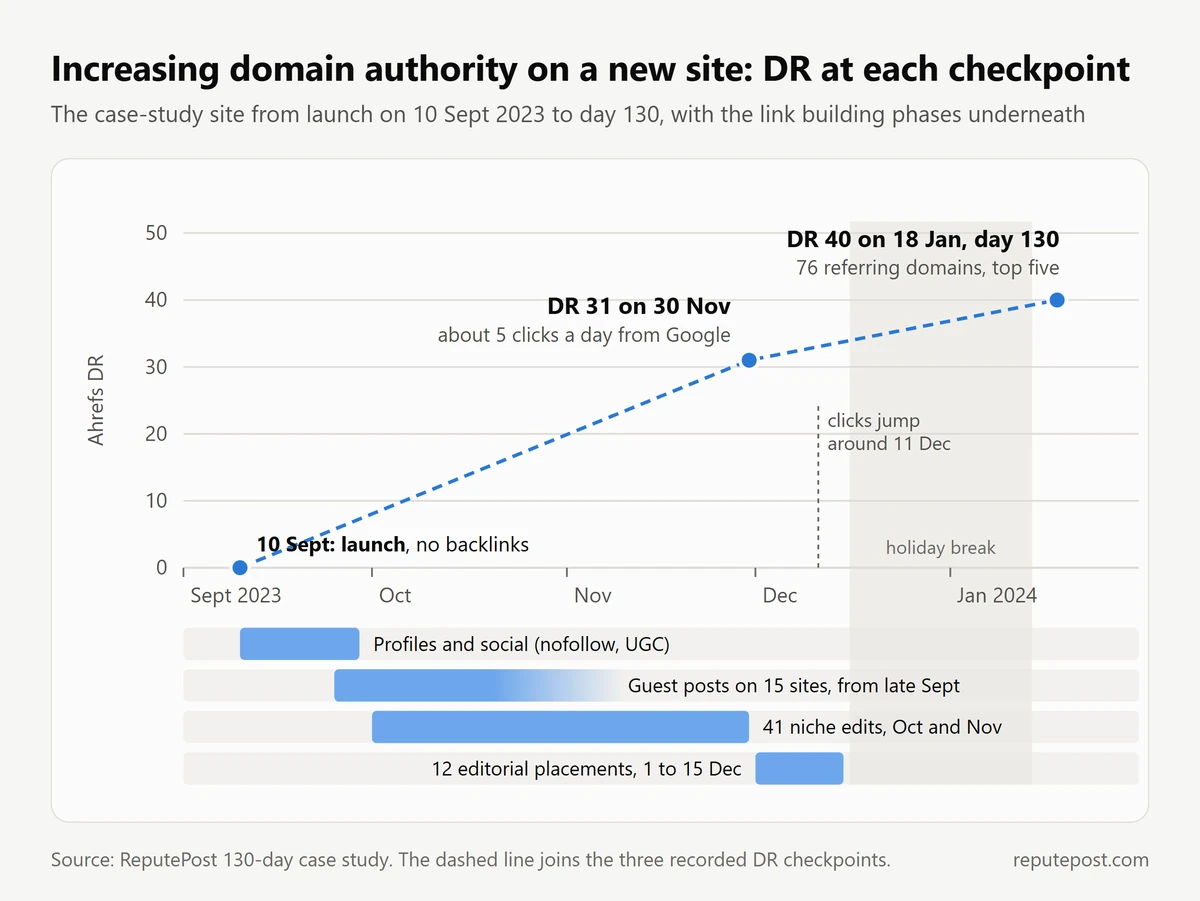
The case-study site's DR at its three recorded checkpoints, with the link building phases underneath. The line joins the checkpoints; DR wasn't recorded in between.
Two things from this case apply to any site. The score moved first: DR 31 arrived with almost no traffic, and the first jump in clicks came in December, the top-five rankings in mid-January. And the target was never a round number: DR 40, not 70, was enough for the top five in that niche. The full 130-day case study has every phase, the outreach numbers and the original Search Console reports.
We also talked the case through on the Repute Post YouTube channel. The video below starts at the DR 31 checkpoint.
Video (15:31): DR 31 comes up at about 5:31 and DR 40 at about 8:49.
How to increase domain authority fast
You can speed up how quickly you get good links. You can't speed up how the scores, or Google, react to them. Search "how to increase my domain authority" and you'll find offers promising a DA of 50 or more within weeks. Here's what can be sped up and what can't.
What you can speed up
Finding the right sites. A link gap report gives you a shortlist of sites that already link in your niche, instead of weeks of cold outreach.
Getting placements live. A placement on an existing site goes live in days rather than after weeks of follow-ups. ReputePost delivers niche edits in 2 to 14 days and guest posts in 1 to 10.
Claiming the links you're owed. Unlinked mentions and links to dead pages, from days 15 to 45 of the plan, cost nothing but time.
What you can't speed up
The scale. Ahrefs calls DR logarithmic, and Moz says it's easier to grow DA from 20 to 30 than from 70 to 80. Each point costs more than the last.
Other sites. Both scores are relative, so your number can drop while you gain links if others gain more.
Discovery. A link only counts in DA or DR once the tool's crawler has found it, and in Google once Google has crawled it.
Traffic. In the case above, DR 31 came with about 5 clicks a day. The rankings came weeks later.
The fast offers work on the score, not on rankings. Ahrefs says DR doesn't take link spam into account, so links from networks built to sell links can push the number up and do nothing for rankings. Worse, Google's spam policies say sites that break them "may rank lower in results or not appear in results at all". A score bought that way also stops telling you anything about your real progress.
Paying for placements vs buying spam links
The case study site paid for its December placements, and most of the link offers you'll come across are paid too, so it's worth being exact about the difference.
Spam links are sold by the number. They include "DA 50 guaranteed" packages, private blog networks, link farms, automated profile and comment blasts, sitewide footer links, and sites that exist only to sell links and get no search traffic. They can move a tool's score and do little else.
Placements on vetted editorial sites are articles on real sites with organic traffic and readers. An editor reviews the content, the topic fits, and the link sits inside the text where a reader might click it. On ReputePost a site can only list after a manual review: 1,000+ organic visitors, DR 20 or higher, rankings for real keywords and no history of Google penalties.
Here is the part that applies to both. Google's spam policies class buying links for ranking purposes as link spam, and that includes "exchanging money for links, or posts that contain links". Google also says paid links are fine when they carry rel="sponsored" or rel="nofollow", but a link marked that way won't raise DR, because Ahrefs only counts followed links. So vetting doesn't change how Google classes a paid, followed link. What it changes is everything around the link. Will real people read and click it? Is the page it sits on indexed and getting visits? Does it look like the rest of your link profile, or stick out?
If you do pay for placements, make that decision with the risk in view. Choose sites you'd want a link from even if Google ignored it, keep the anchor text natural, and keep building links that cost nothing but effort. Unpaid editorial links, where a writer cites you because your page is the best source, carry none of this risk and count in both tools.
Moz DA vs Ahrefs DR: how to increase each
DA and DR measure the same idea with different link indexes and formulas, so one site gets two different numbers. Neither is the right one. Pick one, track it the same way every month, and use the other as a second opinion.
Moz Domain Authority (DA) | Ahrefs Domain Rating (DR) | |
|---|---|---|
Scale | 1 to 100; every new site starts at 1 | 0 to 100, on a logarithmic scale |
Calculated from | Moz's link index, through a machine learning model: linking root domains, the quality of those links and other signals that correlate with rankings | The unique domains linking to you with followed links, their DR, and how many other domains each of them links to |
Can drop with no links lost | Yes: other sites' scores shift, and Moz updates its index and model | Yes: other sites gain links and push yours down the scale |
Used by Google | No | No |
Free check | Moz's Domain Authority checker | Ahrefs' Website Authority Checker |
How to increase Moz domain authority
Get links from more root domains, and from domains with strong link profiles. Moz's model is built to predict how likely a domain is to appear in Google's results, so it rewards the kind of link profile that ranking sites have. Check in Moz's Link Explorer that your new links have been found, because a link Moz hasn't crawled can't count toward DA. Expect the odd jump that has nothing to do with you. Moz lists index updates and model changes, such as Domain Authority 2.0 in 2019, among the reasons scores change.
How to increase domain rating (Ahrefs DR)
The answer to how to increase DR is narrower, because Ahrefs has spelled out what counts:
Only followed links. Nofollow, sponsored and UGC links don't improve DR.
Referring domains, not backlinks, so a second link from the same site adds nothing.
Each linking site's rating, split equally among all the domains it links to (the diagram in the plan above).
Nothing else: Ahrefs says DR doesn't take traffic, domain age or link spam into account.
That last point cuts both ways. A link from a high-DR site with no readers can lift your DR and do nothing else for you. That's why the plan checks a site's traffic before its DR.
When to stop watching the number
Once your DA or DR is level with the sites ranking above you, more points do less. What matters then is links to the exact pages you want to rank, and pages good enough to hold those rankings. Google doesn't use either score, and it ranks pages, not domains. The site in the case study reached the top five at DR 40 and held its rankings until the project ended in April 2024.
So write down three numbers today: your DA or DR, your referring domains and the middle score of the sites above you. Check them again on day 90.
Related articles
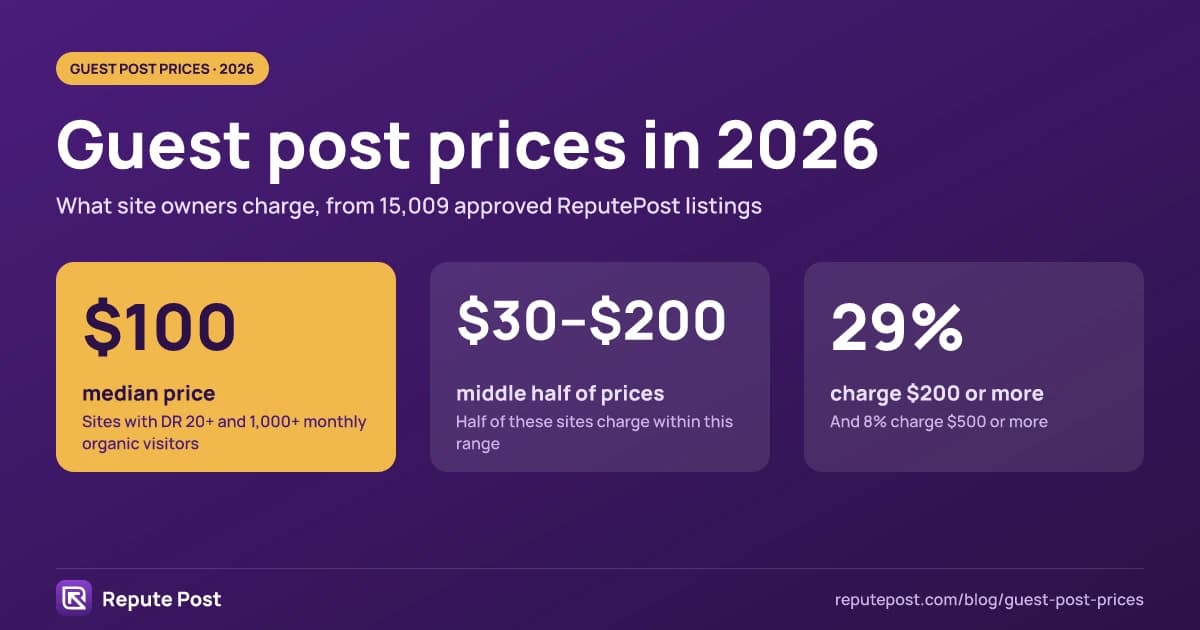
Guest Post Prices in 2026: What a Guest Post Costs by Traffic and DR
Real guest post prices from 15,009 approved ReputePost listings: medians by monthly traffic, DR and niche, how prices are spread, what writing the article adds and how to tell if a price is fair.
10 min read
Cheap Backlinks: What $10, $50 and $100 Really Buy
Ten $10 links, two $50 links or one $100 link? We sorted 15,812 approved listings by price to show what cheap backlinks really buy, the red flags in cheap offers, and how to buy safely.
19 min read
How Much Do Backlinks Cost? Prices by Link Type in 2026
Most backlinks cost $0 to about $600 in November 2026. Our 15,812 listings show traffic, not DR, sets a guest post's price. Rate card, budgets and checks.
15 min read