
Is Buying Backlinks Safe? What Google Says and How to Lower the Risk
Google's rule on paid links, what Search Console shows when it's broken, eight ways of buying set against the policy, and a one-page link buying policy your team can copy.
Hamza Haroon
· 14 min read
Is buying backlinks safe? Not fully: Google treats a paid link that passes ranking credit as link spam, and the outcomes it describes run from the link being ignored to a manual action against your site.
We run a link marketplace and sell guest posts and niche edits, so weigh what follows with that in mind. The rule applies to links bought from us exactly as it does anywhere else.
Inside: the rule, what follows when it's broken, eight ways of buying set against the policy, answers for four kinds of site, and a policy your team can copy. What we say about Google comes from Google's own pages, read on 24 November 2026.
The rule: what Google says about paid backlinks
Google's spam policies (last updated 23 November 2026) define link spam as creating links mainly to manipulate search rankings. Buying or selling links for ranking purposes is the first example on the list. On paid backlinks, Google counts far more than cash as payment:
- Money for a link, or for a post that contains one.
- Goods or services given in return for a link.
- A product sent to someone who writes about it and includes a link.
- A link back, once exchanges become excessive or a partner page exists only to cross-link.
- A contract or terms of service that require a link and leave the other site no choice over how to mark it.
Two kinds of placement are named as well: paid articles whose links pass ranking credit, and articles, guest posts or press releases on other sites with anchor text written for rankings.
So can you buy backlinks at all? Yes. The same page says that buying and selling links is a normal part of advertising and sponsorship, and that such links don't break the policy when they carry rel="sponsored" or rel="nofollow". Google prefers sponsored for paid placements and still accepts nofollow. The breach is a paid link with no mark on it, bought to lift a ranking.
Two points in the wording are easy to miss. The test is purpose, so a good article on a good site gets no exemption if the link in it exists to move a ranking. And the page covers more than the ordinary results: trying to manipulate the generative AI responses in Google Search counts as spam too.
Google's policy isn't law. Advertising rules are a separate question. In the US, the FTC's guide to native advertising says advertisers are responsible for making paid articles recognisable as ads, and that everyone who helps create them should make sure they don't mislead readers.
What actually happens when you buy backlinks
Google says it finds policy breaches with automated systems and, where needed, human review. For paid links that comes down to two outcomes, and they leave very different traces in Search Console.
Outcome one: the links stop counting
Google says that in most cases its algorithms find spam without a reviewer. Its Penguin system has run in real time since September 2016, devaluing spam instead of marking down a whole site. In December 2022 Google turned SpamBrain, its AI-based spam system, on links. SpamBrain can detect sites buying links as well as sites used to pass them, and any credit those links passed is lost.
Spam updates keep coming. Google's status dashboard lists four so far in 2026, in March, June, August and September. A link that counted last year can stop counting in any of them.
The Manual actions report covers reviewers' decisions only, so here it stays clean. The Links report still lists the links, because it shows links Google has found over time, some of them since removed, and doesn't say which are nofollow. What you may see is the target page's clicks and positions failing to move, or slipping around a spam update.
The loss is final. In Google's words about link spam updates: "Any potential ranking benefits generated by those links cannot be regained."
Outcome two: a manual action
A manual action means a human reviewer at Google has decided that pages on a site break the spam policies. Google's Manual actions help page lists one for each side of a link sale. The buyer's is called "Unnatural links to your site". The seller's is "Unnatural links from your site", so site owners who sell links face a risk of their own.
Google tells you in the report itself and in Search Console's message center. The action can cover part of a site or all of it, and affected pages can rank lower or drop out of results altogether.
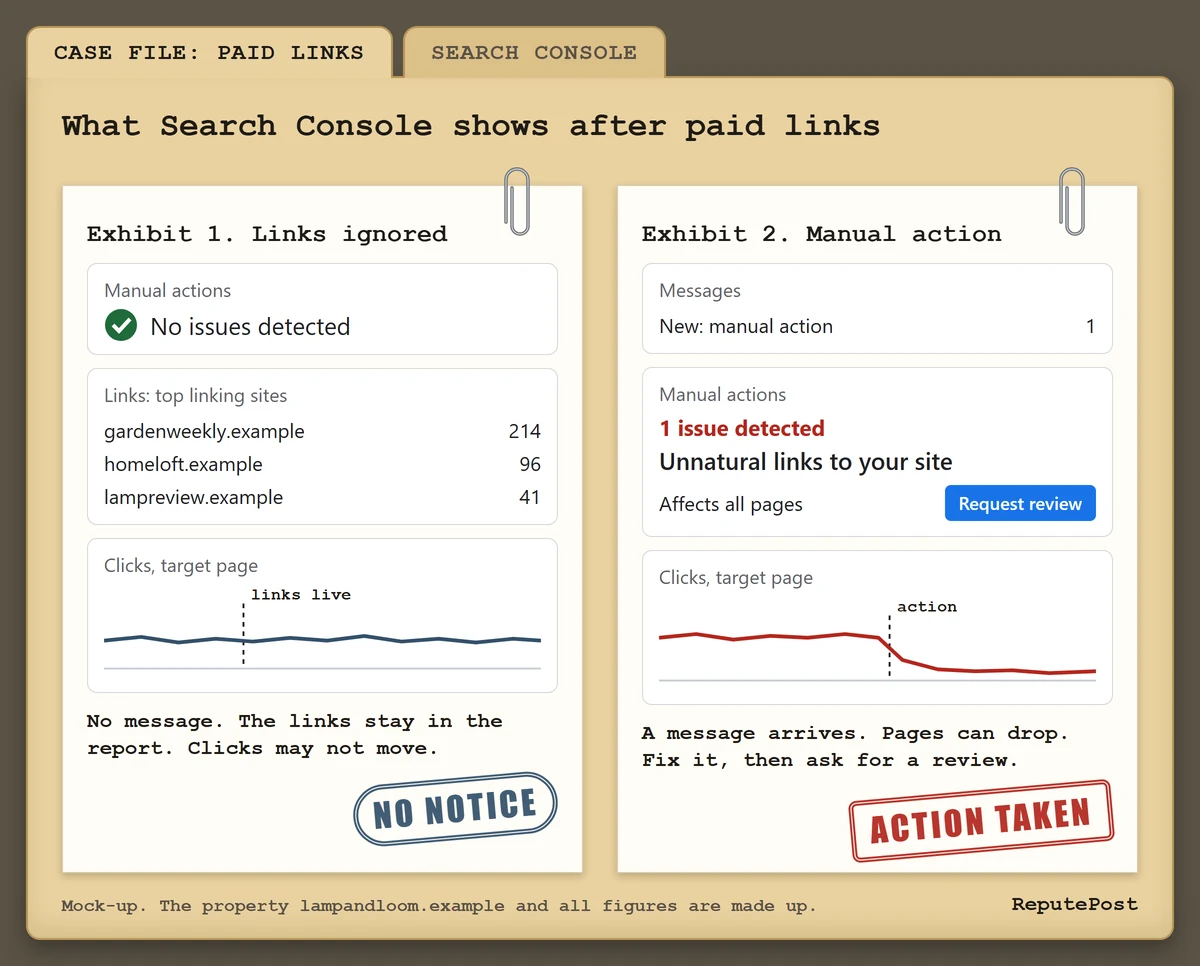
Two exhibits from a made-up property, lampandloom.example. When links are ignored, the report stays clean. When a reviewer steps in, there is a message and a manual action to fix.
What recovery takes
For the buyer, Google's instructions come down to four steps:
- Export your links from the Links report. Start with the sites that link to you most and the newest links.
- Ask each site owner to remove the paid link, or to add nofollow or a more specific value such as sponsored.
- Disavow only the links you couldn't get removed. Google warns that disavowing everything without trying removal first might get the request rejected.
- Choose Request Review, with a record of the links you had removed and an explanation for the rest.
Most reviews take several days or weeks, and Google says link-related ones may take longer. If yours passes, the manual action is revoked. By then the links are gone, marked or disavowed, so whatever they were adding has gone with them.
With no manual action on file, you can probably leave the disavow tool alone. Google says most sites won't need it. It's meant for sites with a considerable number of bad links that have caused a manual action or likely will, and used wrongly it can harm a site's performance.
The risk ledger: eight ways of buying backlinks for SEO
The ledger sets each way of buying against the policy's wording. "Likely outcome" is our reading of Google's pages and carries no odds. The last column says what would bring the risk down.
| Way of buying | What is bought | What the policy says | Likely outcome | How the risk drops |
|---|---|---|---|---|
| Link packages | A set number of links on sites you don't choose, often placed by software | Names paying for links, and automated services that create them | Ignored. A visible pattern can bring a manual action | Barely. With no site list there is nothing to inspect before paying |
| PBN posts | Articles on a network of sites kept to pass links, often on expired domains | Link spam. Filling expired domains with low-value content to manipulate rankings is a separate violation | The whole batch stops counting together | It doesn't. Skip |
| Sitewide or footer links | One link repeated across a site's template | Names widely distributed footer and template links | Ignored, and easy to spot in a links export | Ask for one link in one article, or mark a real sponsor badge |
| Sponsored posts with no label | A paid article with followed links | Names paid articles whose links pass ranking credit | Either outcome, for buyer and seller | Add rel="sponsored" and a visible label, which turns it into the last row |
| Niche edits | Your link added to a published article | Paying for a link is covered, however old the page | Unmarked: either outcome. Marked: no policy problem | Mark it, and pick pages whose readers need yours |
| Digital PR retainers | Time spent pitching stories to journalists | Doesn't list paying for pitches. Names paid articles, and press releases with optimized anchors | Low while editors choose freely. A paid or guaranteed placement is a paid link | Write into the contract that no outlet is paid, and keep anchors plain |
| Reciprocal deals | A link in return for a link, product or service | Names excessive exchanges, and goods or services given for links | A few real partners: little to object to. Swap rings: either outcome | Link where readers gain, and mark links from gifted products |
| Guest posts marked sponsored or nofollow | The same article with the link marked | Not a violation | No policy problem. Google says marked links generally won't be followed | Already low. Judge it on its readers |
Two questions settle most rows. Was something given for the link? If so, is the link marked? Site quality doesn't come into it. A strong, relevant page makes a marked link worth paying for, but it can't make an unmarked one compliant.
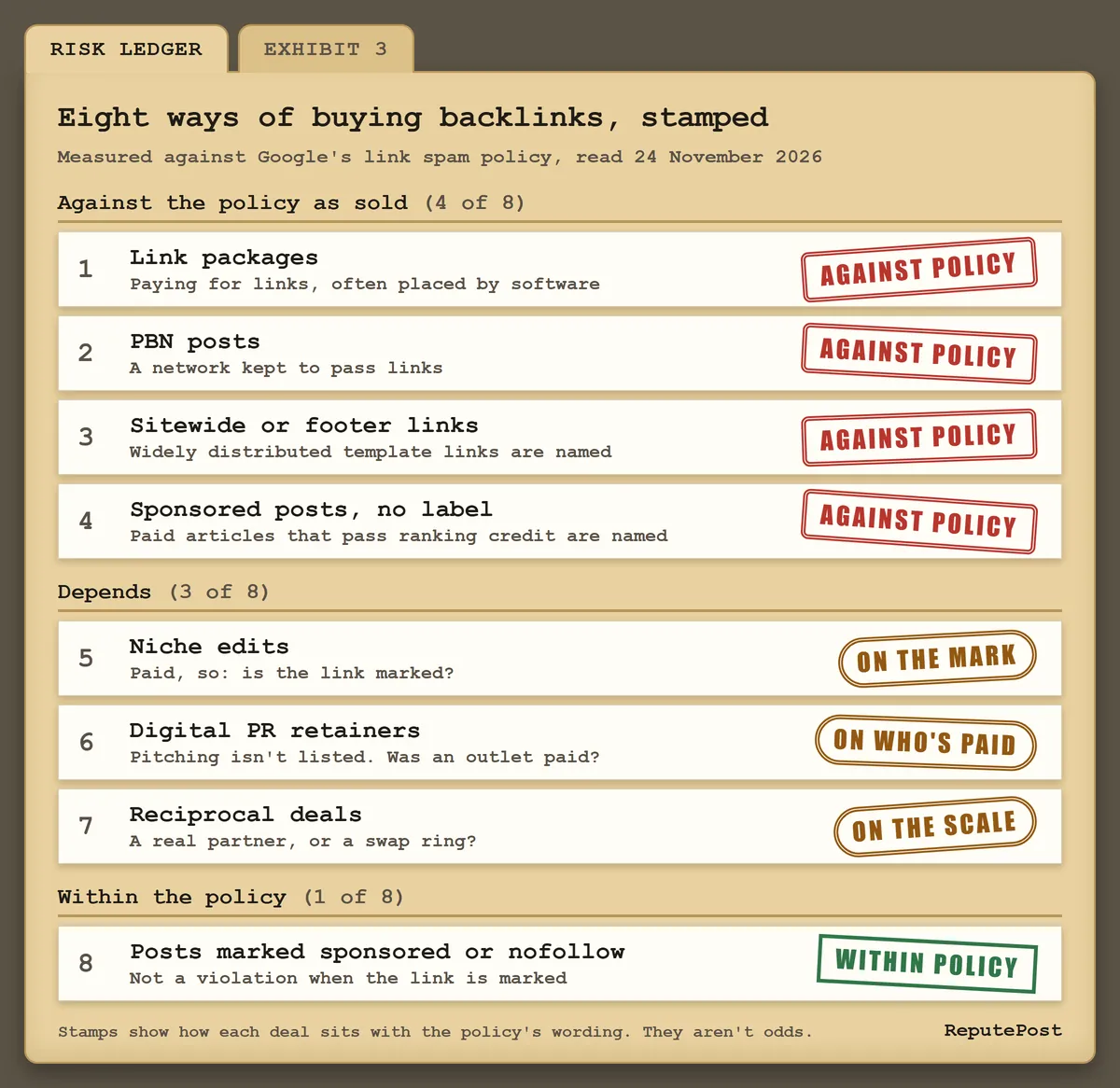
The ledger as stamped slips. Four deals break the policy as they're usually sold, three depend on the details, and one sits within it.
Should you buy backlinks? Four situations, four answers
Is buying backlinks a good idea? As paid exposure, with the link marked and real readers behind it, it can be. As a way to buy rankings, it's a bet against Google's written policy, and how bad a bet depends on what you could lose.
A new site: not as the first move. New pages need something worth citing before they need paid placements. Publish that first, then claim the links you're already owed by suppliers, partners and profiles. Bought placements can work. For one new site in 2023 we paid for some of the placements, and its main pages were in Google's top five by day 130. That shows paid links can move rankings. It doesn't show they're safe, and it's one site.
A steady site with rankings to protect: only links you'd want with the tag on. You have the most to lose, because one manual action can cover every page. Pay for audiences instead: a sponsored article in a trade publication your buyers read is still worth having when the link is nofollow.
An agency buying for clients: only with written consent. The manual action lands on the client's site. Tell them which links are paid, how each one is marked and what Google's policy says, and keep their answer on file.
A site that has had a manual action: no unmarked paid links at all. Google's spam policies have a section on circumvention, and a site that keeps working around the rules can have more of its pages removed from Search. Finish the clean-up, wait for the action to be revoked, then spend on links you earn.
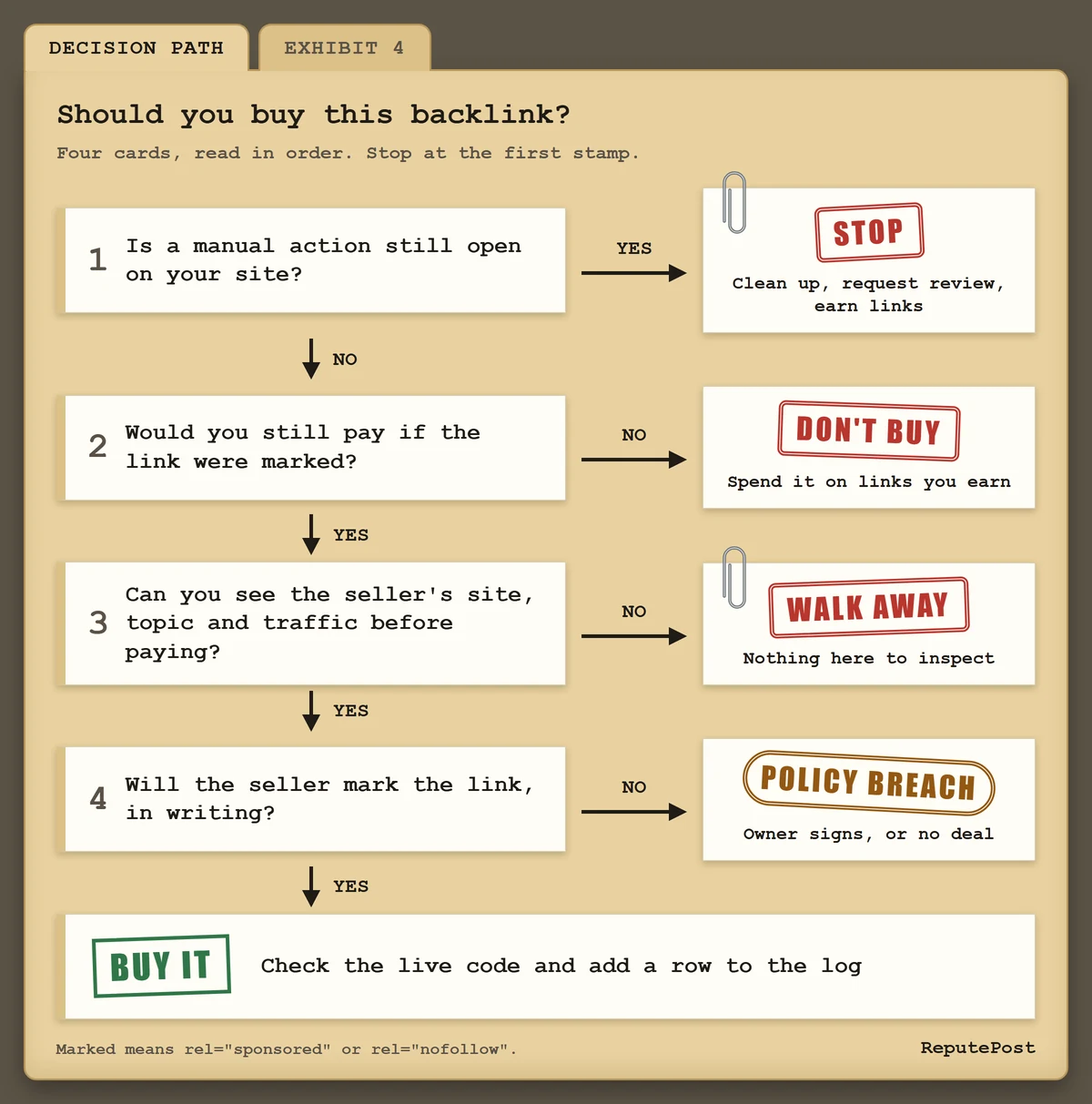
The decision path on index cards. Any one of the first three stamps ends the purchase. The fourth is a risk only the site's owner can accept.
How to lower the risk when paying for backlinks
Marking the link is the only step that settles the policy question. The other five make sure a marked link is worth its price, and keep any mistake small enough to undo.
Labelling. Agree in writing, before you pay, that the link will carry rel="sponsored" or rel="nofollow", and ask for a visible label on the article. Don't assume a site has a rule of its own: when we read the rules on 52 open submission pages on 20 November 2026, 16 said nothing about what happens to your link. Paste the HTML for each rel value into your brief so nobody has to guess. When the page goes live, open its source and check.
Relevance. Choose pages whose readers might need yours next. Judge how well the two pages match, because a site's category says little about who reads one article.
Real traffic. A link nobody sees has only ranking credit to offer, and that's the part a marked link gives up. Ask for organic visits to the page as well as the site. By 17 November 2026 our marketplace had turned down 7,543 sites, and every one had fewer than 1,000 monthly organic visitors.
Anchor mix. Optimized anchor text in articles and guest posts is named in the policy. Use your brand, the page title or the plain URL, and let the editor settle the wording.
One search our pages appear for asks: I need guest post placements with specific anchors and target URLs, can services handle that safely? A service can place the URL you name. It can't make a keyword anchor safe in an unmarked paid post, so fix the target page and leave the anchor loose.
Pace. Buy no faster than you can check. A few placements a month, each one opened, read and logged, shows you early when a seller's sites go bad. Measure the gap between your page and the ones above it before you set a number.
Records. Keep the URL, the date, what was given and to whom, the anchor and the rel value. A reconsideration request needs documentation of the links you had removed, and you can't document what nobody wrote down. If you already report on links, the columns to track are much the same.
Are backlink marketplaces safe for SEO?
Only as safe as the links bought through them. A marketplace doesn't change the rule: a link bought on one is a paid link, whoever vets the sites. What a good one changes is how much you know before you pay. With each listing on ReputePost you see the site itself, its DR, organic traffic and price, and a person has checked every site. Each listing also shows the link types its publisher allows, and a link ordered as sponsored is marked rel="sponsored". Your payment is held in the wallet until the order is complete, and you can open a dispute if a publisher removes the link.
No marketplace, ours included, can promise how Google will treat a link, so settle how it will be marked before you order. And walk away from any seller that hides the sites until you've paid, advertises "no sponsored tag" as a feature, or sells one package to every niche.
Where buying links fits, and where earned links are the better spend
With paid backlinks, SEO credit is the part you can't count on once the link is marked. Count the rest: visits, sign-ups, and people who hear of you for the first time. On that basis, paying makes sense for:
- a sponsored article or newsletter slot in a publication your customers already read;
- a guest post or niche edit on a page with steady readers of its own, where your page answers their next question;
- sponsorship of an event, podcast or charity you'd back anyway, with the link marked.
Earned links are the better spend when:
- you have data, a tool or a story nobody else has, because pitching it can win coverage an editor chooses to give;
- suppliers, partners or customers already mention you without linking;
- the page has to hold its position for years, since a paid, unmarked link can be discounted in any spam update;
- the site has had a manual action, or losing its traffic would close the business.
A one-page link buying policy to copy
- We count money, free products, services, discounts and link swaps as payment for a link.
- Every paid link carries rel="sponsored", or rel="nofollow" where a site can't add sponsored. We agree this before paying and check the code when the page goes live.
- An unmarked paid link breaks Google's spam policies. Only the site's owner can accept that risk, in writing, and never for a site that has had a manual action.
- We pay for a placement only if we'd still want it with the link marked: right topic, real readers, a page we have opened and read.
- We don't buy packages, network links, sitewide or footer links, or anything on sites we can't see first.
- The editor words the anchor. We suggest our brand or the page title, never an exact-match keyword.
- One named person approves each placement before money moves.
- Each placement gets a row in the log: URL, live date, what was given and to whom, anchor, rel value, approver.
- We check the Manual actions report every month and re-open every logged link each quarter.
- If a manual action arrives, buying stops that day, the log becomes the clean-up list, and nothing more is bought until Google revokes it.
Related articles
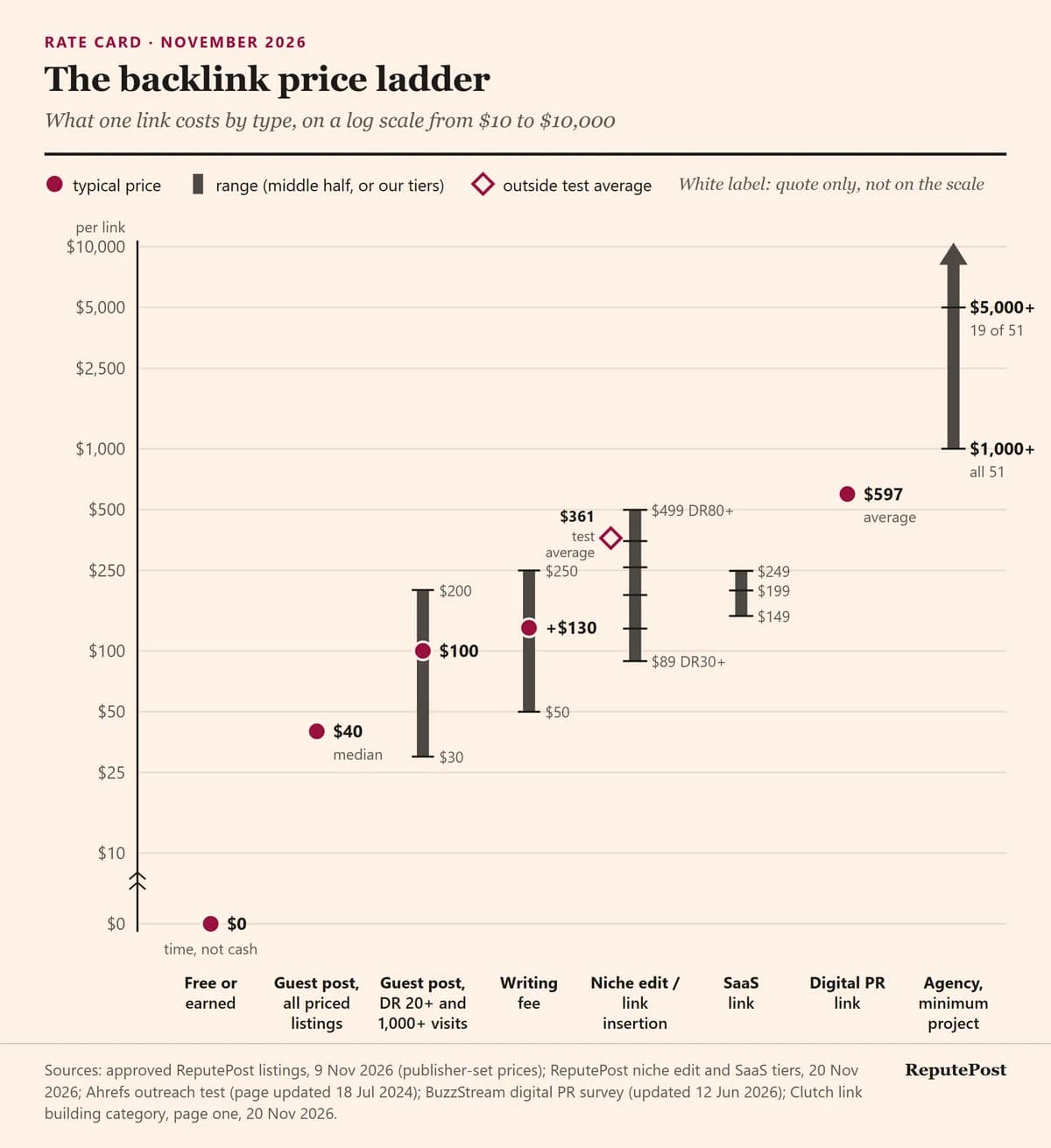
How Much Do Backlinks Cost? Prices by Link Type in 2026
Most backlinks cost $0 to about $600 in November 2026. Our 15,812 listings show traffic, not DR, sets a guest post's price. Rate card, budgets and checks.
15 min read
How to Find Backlinks to Your Website for Free
Five free ways to find backlinks to your website, with real Search Console and Bing screenshots: what each tool shows, its limits, how to check a link you find, and when to disavow (rarely).
15 min read
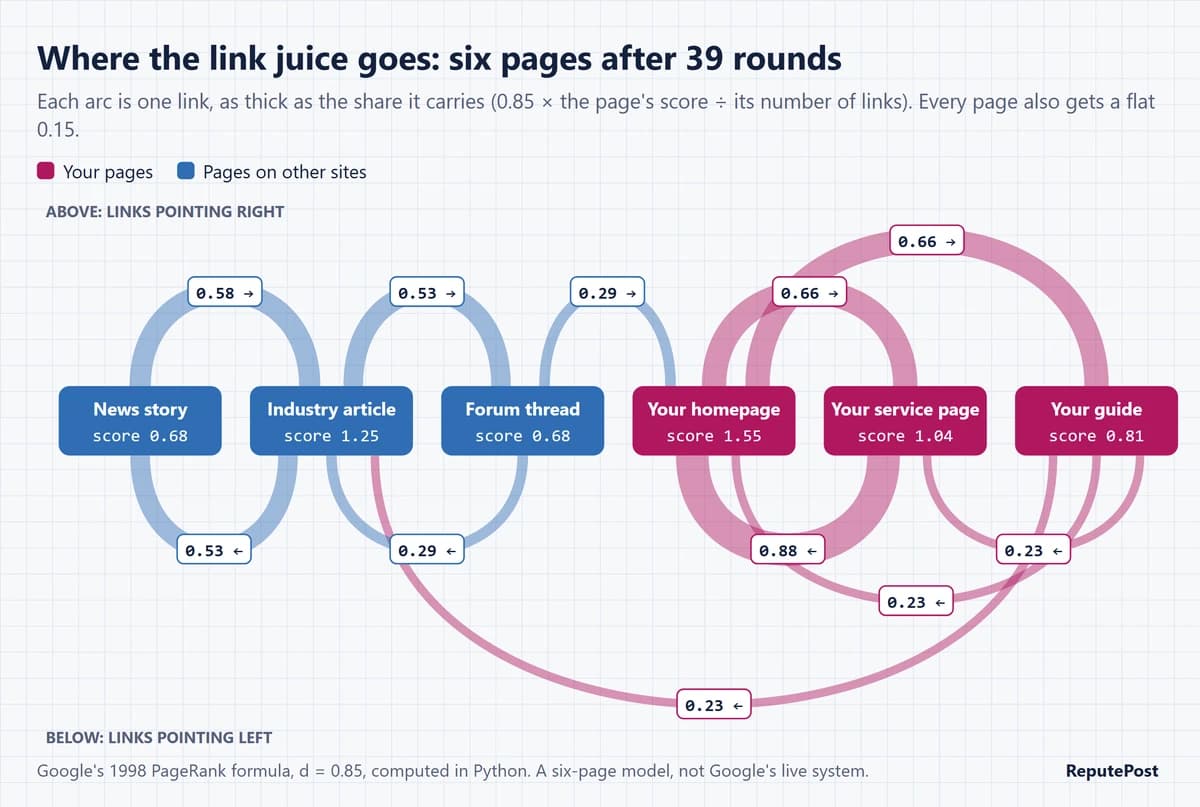
Link Juice in SEO: How Backlink Juice Flows
Six pages, Google's 1998 PageRank formula and 39 rounds in Python: where link juice flows, what nofollow, redirects and crowded pages do to it, and which links carry the most.
19 min read