
Guest Posts vs Niche Edits: Which to Buy, and When
Guest posts vs niche edits scored over eight rounds, with a pick for five situations, what outreach really buys, Google's policy on both, and a three-month mix.
Hamza Haroon
· 15 min read
Guest posts vs niche edits, as a rule of thumb: pick a niche edit when you need a link soon on a page people already visit, and a guest post when the article itself has to be yours. Most sites need some of both, so the useful question is which one this page gets first.
We sell both, so read the scores with that in mind.
Guest posting vs niche edits: the eight-round scorecard
A guest post is a new article on someone else's site with your link in it. A niche edit, or link insertion, puts your link into an article that is already live (here's how one edit is made, stage by stage). Each round asks one question about the link you end up with. If the answer depends on the deal more than on the type of link, the round is a draw. The scores are our own view, with figures behind them where we have any.
| Round | Winner | Why |
|---|---|---|
| 1. Time to live | Niche edit | There is no article to write and approve before the link can go live. |
| 2. Control over the text | Guest post | You choose the topic and write every paragraph. An edit gives you a sentence or two in someone else's article. |
| 3. Relevance to the target page | Guest post | The article can be planned around the page it links to. An edit needs a matching article to exist already. |
| 4. Traffic from day one | Niche edit | A live article may already rank and get visits. A new post starts with none. |
| 5. Price range | Draw | Guest posts have the lower floor and the wider spread. Niche edits have the simpler bill. |
| 6. Risk of removal or change | Draw | A guest post can disappear with its page. An edit can disappear at the next rewrite. |
| 7. Anchor freedom | Guest post | You write the sentence, so the anchor can read naturally. In an edit it has to fit words that are already there. |
| 8. Scaling | Niche edit | Twenty edits need twenty suitable pages. Twenty guest posts need twenty new articles. |
| Final score | 3-3 | Three rounds each and two draws. |
So link insertion vs guest post ends level, because the two are good at different things. Advice on niche edits vs guest posts often names one winner. Ignore the total instead, and count only the rounds your page cares about. A shop that wants a category page to move before a sale cares about rounds 1, 4 and 8, and niche edits win all three. A software company explaining a new idea cares about 2, 3 and 7, and guest posts win those.
Speed: time to live and traffic from day one
The slow part of a guest post is the article. On 20 November 2026 we read the contributor pages of 52 sites that take guest posts. Of those, 44 gave a word count, with a median minimum of 850 words, and 14 wanted a pitch or outline before any draft.
Buying the placement removes the pitch but not the writing. An edit removes both, because there's only a sentence or two to agree. Ours go live within 2 to 14 days of the order. The gap closes when your article is already written: each listing on our marketplace shows that site's own turnaround, and a finished draft only has that wait ahead of it.
A link can be live before Google has counted it. Google's page on asking for a recrawl says crawling can take from a few days to a few weeks, and that a request doesn't guarantee a place in search results. A guest post has to be found and indexed as a new page. An edited page that's already in the index only needs a fresh crawl.
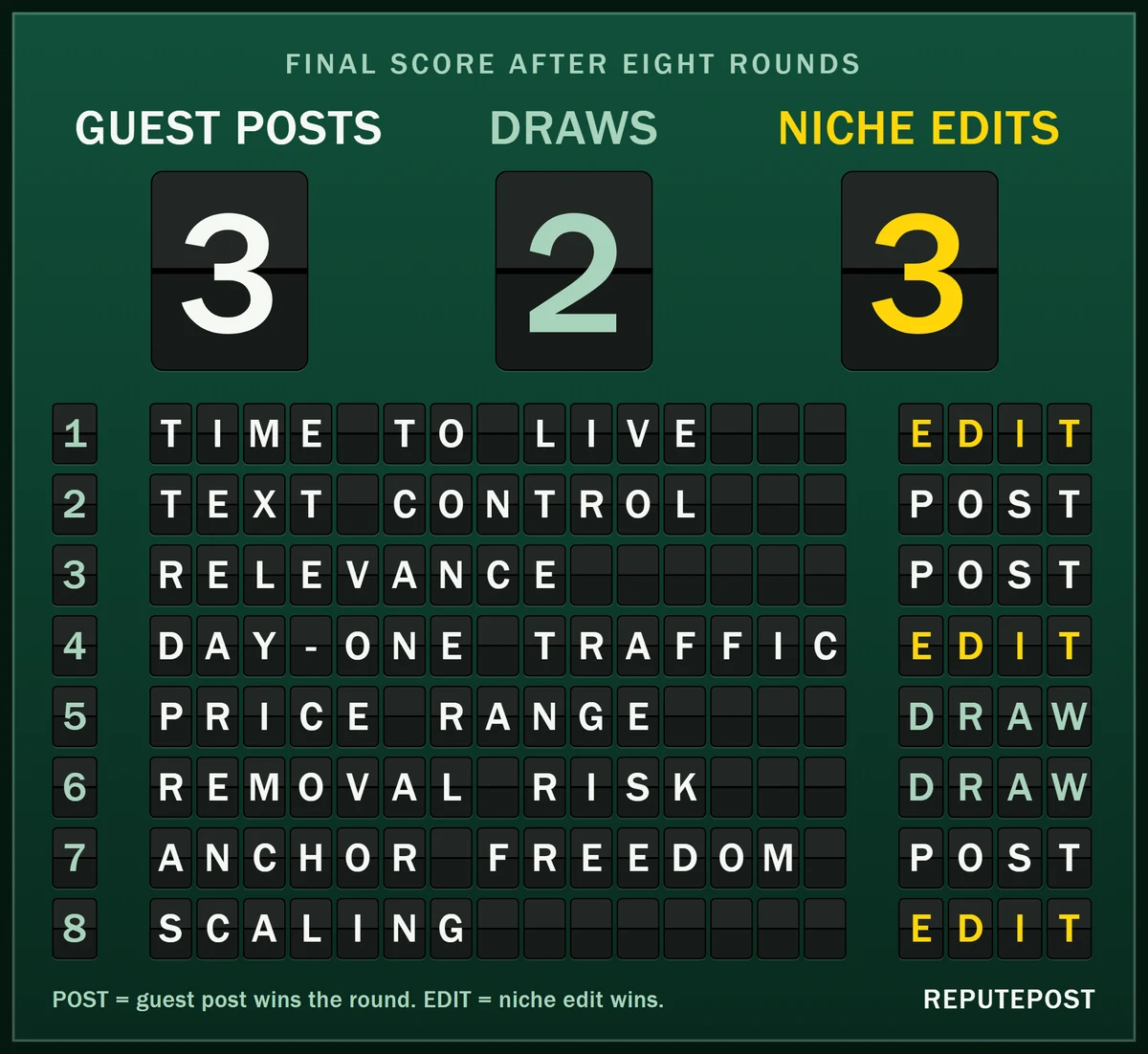
The eight rounds on one board: guest posts take text control, relevance and anchor freedom; niche edits take time to live, day-one traffic and scaling; price range and removal risk are draws.
Round 4 is the clearest win on the board. In a study published in May 2025, Ahrefs followed a million random URLs its crawler saw in September 2023. Within a year, 1.74% had reached Google's top ten. A second sample, limited to English pages with content, gave 6.11%. The same study found that 72.9% of top-ten pages were more than three years old. A guest post is a new page, so expect most of its first readers to come from the host's own audience, not from search.
Two things can reverse that round. An edit on a page nobody visits brings nobody, so check the traffic of that page and not the site's total. And a guest post that goes out in a busy newsletter can get more readers in its first week than a quiet old article will.
Control: the text, the topic match and the anchor
In a guest post you field the whole team. You pick the angle, the examples and the paragraph around the link, and your name or brand can go on it. The host still sets rules. Of those 52 contributor pages, 36 said something about links. 20 let you link from the article, most with a cap of one to three or only to back up a point. 10 keep your link to the author bio, and 2 rule out links to your own site in a standard post. So the words are yours, but the link may not go where you planned.
In an edit you control one player. You can suggest the sentence, and the owner may reword it to match the rest of the page. Everything around it was written earlier, for another purpose.
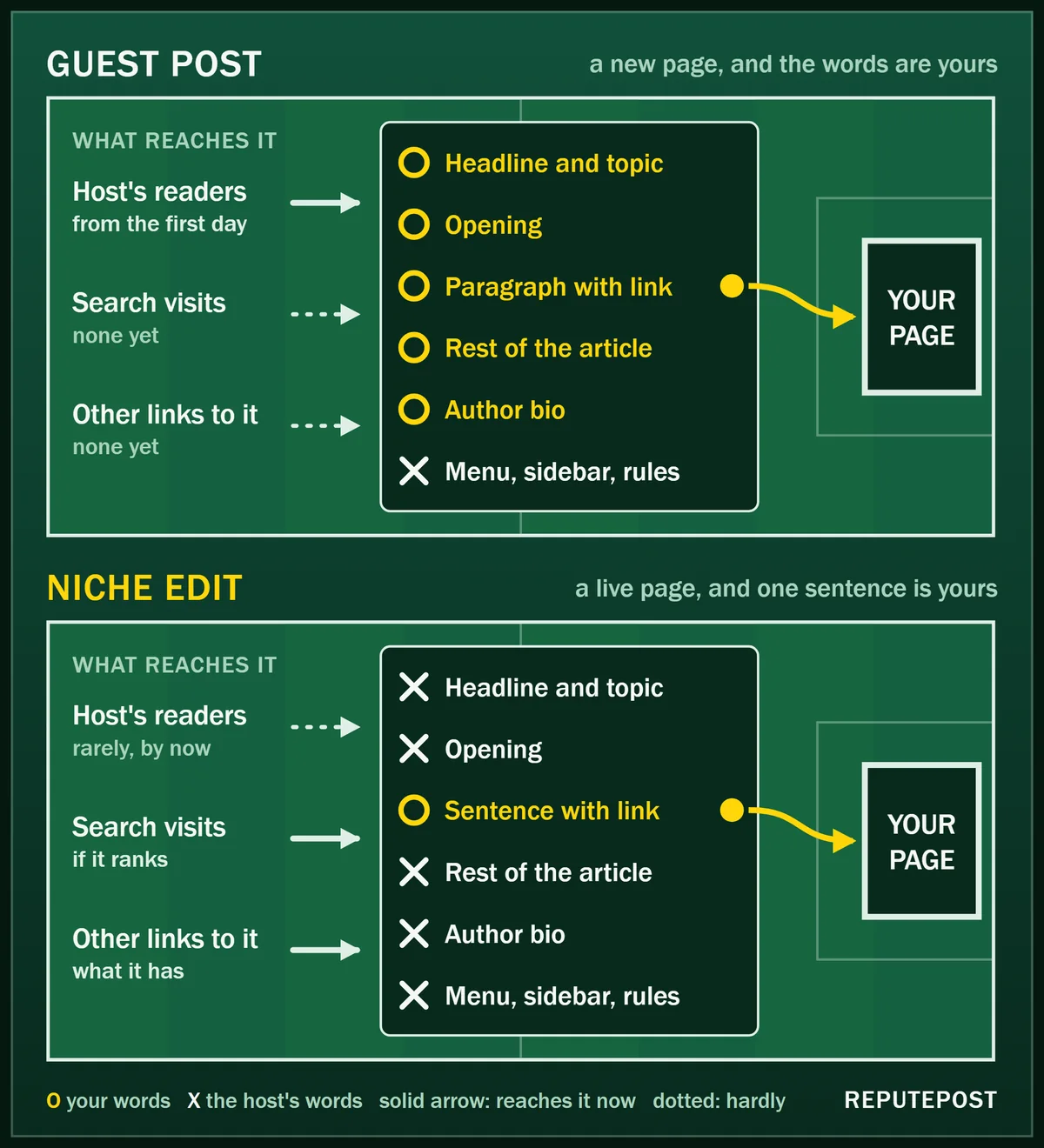
Where your link sits in each: nearly every line of a new page, or one sentence on a page that may already have search visits and links.
Round 3 follows from that. Say your target is a guide to storing an e-bike battery over winter. A guest post can be about getting an e-bike through winter, and the link has an obvious reason to be there. For an edit, somebody must have written that article already. The round flips for a page no editor would build an article around, such as a booking page. One line in an existing guide may be its only natural place. Whichever you buy, give the page that will carry the link a relevance score out of eight first.
Round 7 is where you feel the difference when you compare niche edit links vs guest posts for the same page. In your own article you can write the sentence so a descriptive phrase falls where the link goes. In an edit the anchor has to fit words that were there first, so brand names and plain descriptions sit better than keyword phrases.
That gives a simple split: let edits carry your brand and page titles, and keep the few partial-match anchors you want for articles you write. Don't overuse the freedom. Google's own examples of link spam include links with optimized anchor text in articles and guest posts. Repeating one keyword phrase across a run of guest posts fits that description.
Budget, staying power and scale
Guest posts have the wider price range because site owners set their own prices. On 9 November 2026, 5,757 approved ReputePost listings had DR 20+ and at least 1,000 monthly organic visitors. The middle half of their publisher-set guest post prices ran from $30 to $200, with a median of $100. The article is often a separate line: 4,904 of them set a writing fee, at a median of $130. With both added together, the median came to $245.
Niche edits have a narrower range and one line on the bill. ReputePost's niche edit tiers are fixed by the DR of the host site and start from $89, with the paragraph around the link written for you if it needs one. So if you can write, guest posts have the lower floor. If you can't, the writing fee usually lifts them above an edit on a comparable site. For links of other kinds, such as digital PR or a retainer, we keep a rate card of every link type.
Round 6 is a draw because both links can go, in different ways. Ahrefs' link rot study (updated February 2024) looked at 2,062,173 websites and found that 66.5% of the links pointing to them since January 2013 had rotted. Of the lost links, 47.7% were on pages that had dropped out of its index, and 34.2% had been removed from pages that still existed.
The first is the risk a guest post runs: the page gets pruned, or stops being indexed. The second is the risk an edit runs: someone updates the article and your sentence goes. The study doesn't separate the two kinds of link, so it can't break the tie. What can is the seller's answer to one question: what happens if the link goes?
On our marketplace the buyer's money stays in the wallet until the order completes, and the buyer can open a dispute if a publisher takes a link down. Our niche edits page promises a free replacement if a link is removed. Ask about links that never appear, too. In one phase of the campaign described in the next section, we paid for 15 placements and 12 went live.
Round 8 goes to edits because each link takes less work. In October and November 2023 we placed 41 niche edits for one new site, after guest posts on 15 sites. The limit is supply. A narrow topic has only so many live articles where your page is a fair mention, and forcing more edits after that gives up relevance. Guest posts have no such ceiling, because you can always write the next article.
Niche edits vs outreach: what each one buys
Niche edits vs outreach compares two different things. A niche edit is a kind of link; outreach is a way of getting one, by writing to site owners and asking. The real choice is between paying for a finished placement and spending your own hours asking for it.
| Buying a niche edit | Manual outreach | |
|---|---|---|
| What you spend | Money, at a price you know before you order | Hours of research, emails and follow-ups |
| What you can plan on | A number of links and a delivery window | Nothing until a site owner says yes |
| What you choose | The DR tier, the target page and the anchor | The exact sites and people you write to |
| What kind of link it is | A paid placement, so the paid-link rules apply | Often a request for a fee, sometimes a link nobody paid for |
| What's left afterwards | The link | The link and a contact you can write to again |
Outreach isn't free by default. In a new site's first 130 days we pitched guest posts to 23 sites that had already published competitors' articles. 21 replied, and most asked for a placement fee. After dropping the sites that were losing search visibility, we were left with 15.
Blogger outreach niche edits are where the two meet: someone emails bloggers one at a time and asks for the edit. Our own service starts that outreach once an order is paid.
Manual outreach wins when:
- you have something writers cite anyway, such as your own figures, a free tool or a working replacement for a dead link;
- the site you want most doesn't sell links;
- you want the relationship as much as the link, for a quote, an interview or a joint piece;
- you or your client won't pay for links.
Buying wins when you need a planned number of links in a known window, or when nobody has the hours.
How to choose between niche edits and guest posts: five situations
To choose for one page, ask what it lacks. If it lacks an explanation, pick a guest post. If it lacks support or time, pick an edit. Here are five cases, with the rounds that decided each pick.
A new page with no links: guest post first
Decided by rounds 2 and 3. Nothing on the web explains this page yet. A guest post can be written around the question it answers, so the first link arrives with its context. Add edits once the page is indexed and you can see which searches it shows up for. Our 2023 campaign went in that order, guest posts and then edits.
A page stuck on page two: niche edit
Decided by rounds 1 and 4. Google already shows the page for the search, so what it may lack is support. Look for live articles that rank for nearby searches and where your page is a useful next step. Two or three edits there give you an answer sooner than articles that still have to be written.
A brand story: guest post
Decided by rounds 2 and 7. A launch, a founder's argument or a set of findings needs a headline, some room and a name on it. An edit can mention that the story exists but can't tell it. Pick a site your customers read, and judge the post by the visits it sends.
A thin budget: a guest post you write yourself
Decided by round 5. The writing is the part of a guest post you can do yourself, and the figures above show it's often the larger part of the bill. Prices on ReputePost's guest post listings start from $6.50, and a person checks every site before it's listed. Put what you save into one relevant site with real visitors. If nobody on your side can write, one niche edit is the better use of the money.
An agency reporting deadline: niche edits
Decided by rounds 1 and 8. The report goes out at the end of the month and three links are missing. With edits there's no full article for the client to approve, and you know the delivery window before you order. Order early, because our window runs to 14 days. If the report is due sooner, an approved article sent to a listing with a short turnaround is the safer bet.
What Google's policy means for both
Google doesn't score the two differently. Its spam policies (last updated 23 November 2026) treat paying for a link, or for a post that contains one, as link spam when the aim is rankings. They allow such links when they carry rel="nofollow" or rel="sponsored". A bought guest post and a bought niche edit are both paid links, ours included, so both fall under that rule. Each is one attribute in the link's code; here's how to mark up a paid link.
One rule reaches guest posts first. The site reputation policy on the same page covers third-party content published on a host mainly for the ranking signals that host already has. Google says third-party content is not a problem in itself and lists editorial articles as fine. One of its examples of what isn't fine is a low-quality casino page on a medical site it was never part of. An edit adds no new page, so the link rule is the one to think about.
For a buyer, that means two habits. Agree the rel value before you pay and put it in the order notes, for either type. And turn down a guest post slot that would look out of place next to the host's own articles, however good the numbers are. A deal that only works if the link is left unlabelled carries the risk Google describes, whichever format you picked.
A three-month mix for one site
Take stovecamp.example, a made-up shop selling camping stoves. It has a buying guide at the top of page two, a new stove comparison page with no links, and a founder who tests every stove on real trips. Over one season it gets eight links: five niche edits and three guest posts, plus ten outreach emails.
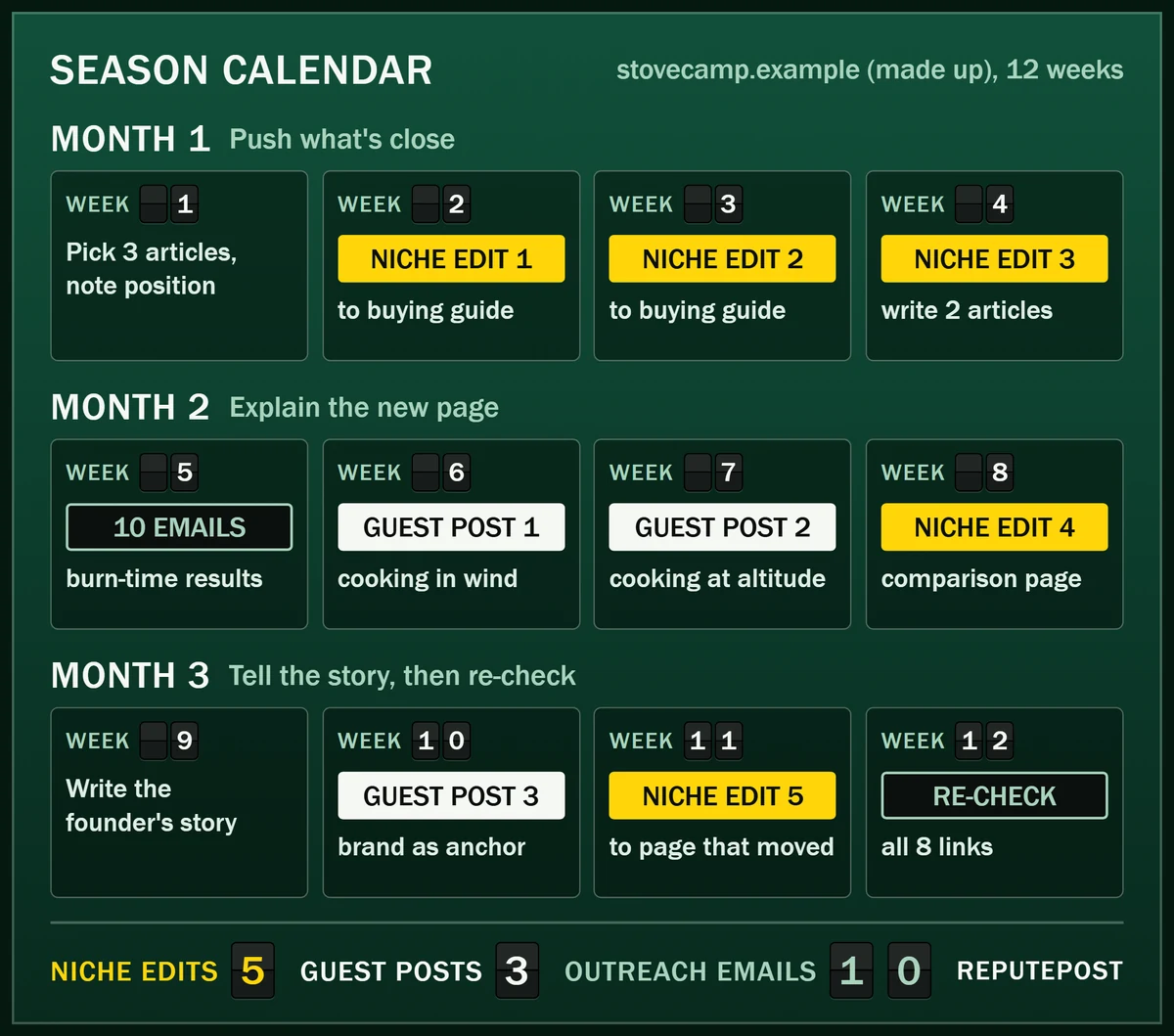
The 12-week mix for stovecamp.example, a made-up shop, ending with a check of all eight links.
Month one: push what's close
Three niche edits go to the buying guide, each in a live article about packing or choosing camping kit that already gets search visits. The shop notes the guide's average position in Search Console before the first one goes live, so there's something to compare with. While the edits are being placed, it writes two guest articles, because the writing is what would hold up month two.
Month two: explain the new page
The two guest posts go live, one on cooking in wind and one on cooking at altitude. Both link to the comparison page, which nobody else has explained yet. Once that page is indexed and showing for a few searches, it gets its first niche edit. In the same month the founder emails ten hiking clubs and blogs, offering the shop's burn-time results free to anyone who wants to cite them.
Month three: tell the story, then re-check
The third guest post is the founder's own account of testing stoves on the trail, under their name, with the brand as the anchor. The fifth edit goes to whichever page moved most, since by now the numbers show where a link helps. Any link the emails earned is a bonus the plan never counted on.
In week twelve the shop opens all eight links and checks that each is still there, with the rel value that was agreed, on a page that is still indexed. Then it fills in its own scorecard: which rounds decided the links that worked, and what that says about the mix for the next three months.
Related articles
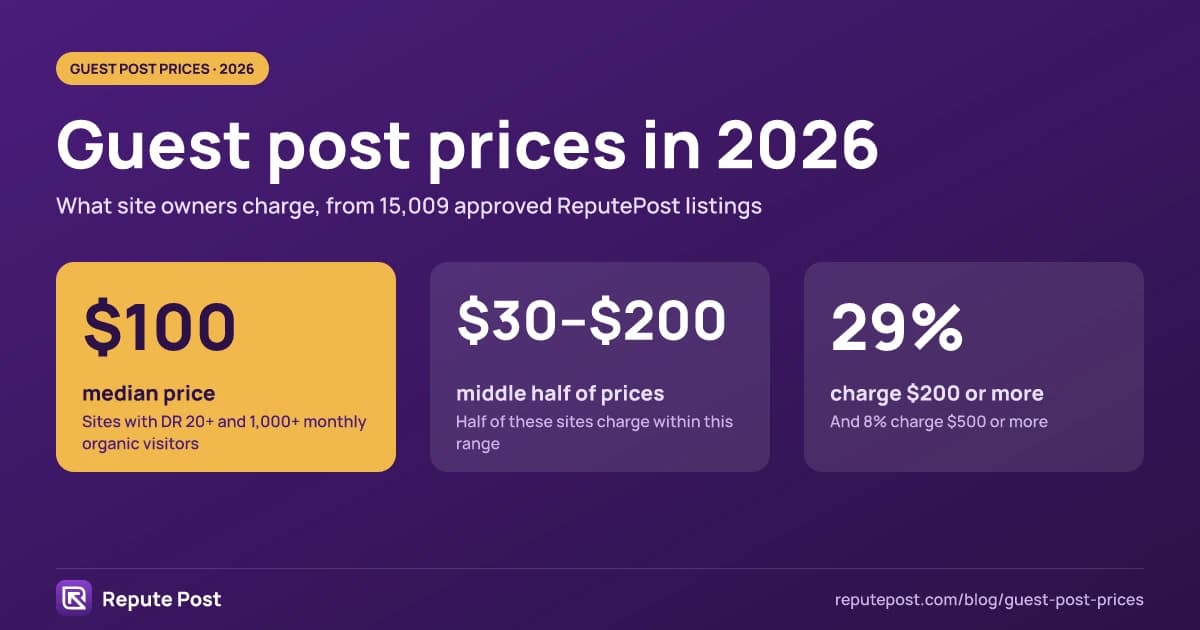
Guest Post Prices in 2026: What a Guest Post Costs by Traffic and DR
Real guest post prices from 15,009 approved ReputePost listings: medians by monthly traffic, DR and niche, how prices are spread, what writing the article adds and how to tell if a price is fair.
10 min read
What Is Guest Posting? A Beginner's Guide to Guest Posts in 2026
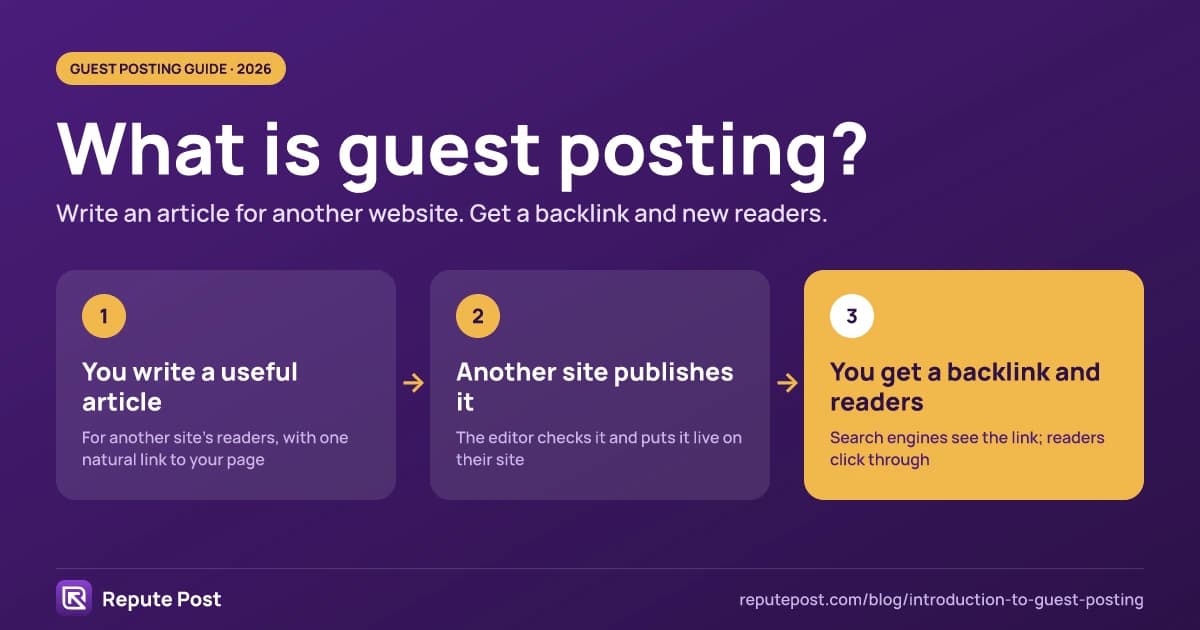
Guest posting explained: what a guest post is, how it works step by step, what Google says about it, free vs paid guest posts, how to find and check sites, and whether it still works in 2026.
13 min read
White Label Guest Posting: The Agency Workflow from Brief to Report
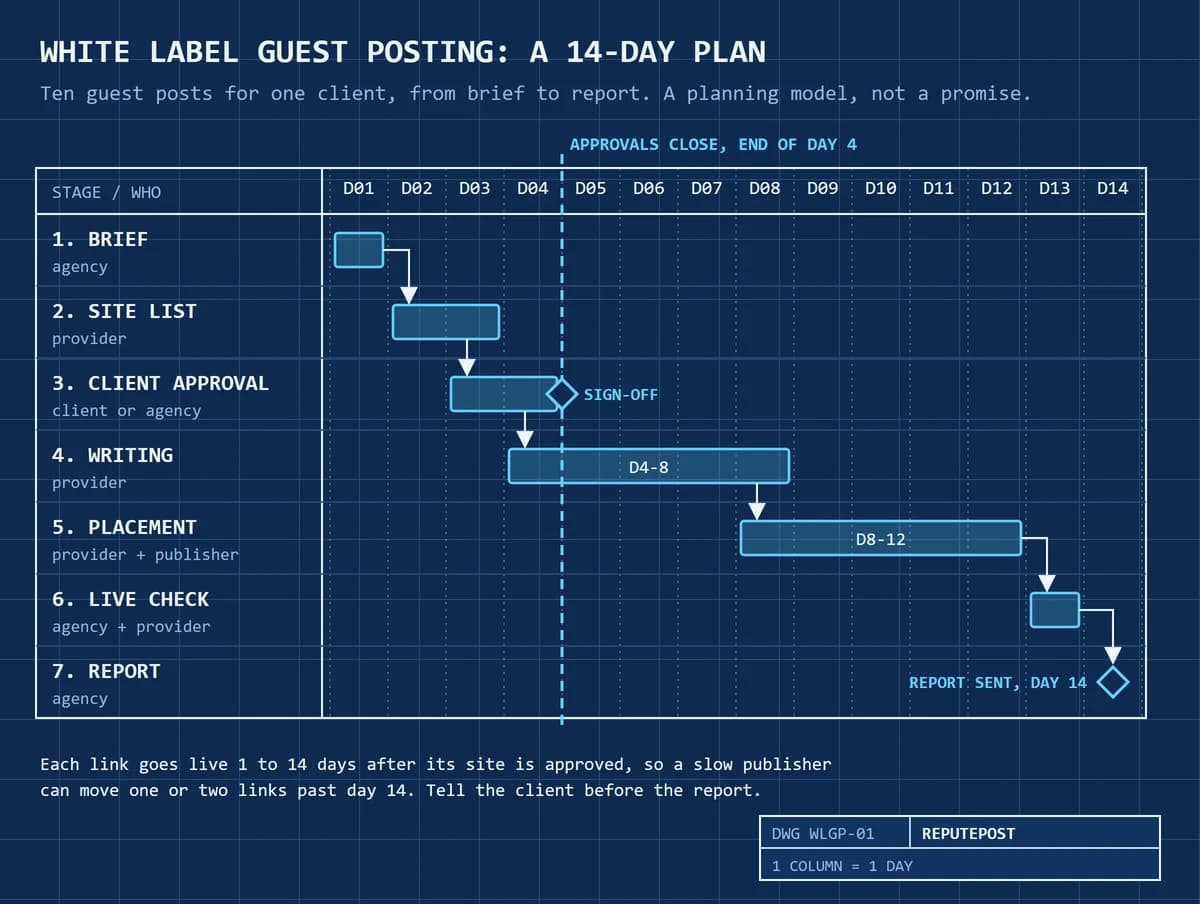
Ten guest posts promised, no outreach team, and a client who must never see a third party. Here is how white label guest posting runs: a 14-day plan, who sees what, the report columns and the margin maths.
16 min read