
14 Types of Backlinks Ranked by SEO Power in 2026
Backlink types explained: the 3 main groups, all 14 types of backlinks ranked in four tiers with an example of each, dofollow vs nofollow, and a side-by-side table of costs and risks.
Hamza Haroon
Updated · 18 min read
Not all backlinks carry the same weight. A single link from a trusted industry publication can do more for your rankings than a hundred links from low-quality directories. The type of backlink, how it was earned and where it sits on the page all decide how much SEO value it passes on.
This guide covers 14 types of backlinks. The strongest are editorial links, guest posts, niche edits and digital PR links. Directory, broken link, image and podcast links help in the right situation. Forum, comment, web 2.0, social bookmarking and footer links carry little weight today, and PBN links break Google's spam policies. Below, all 14 backlink types in SEO are ranked in four tiers, each with an example, how it's earned and why it sits where it does.
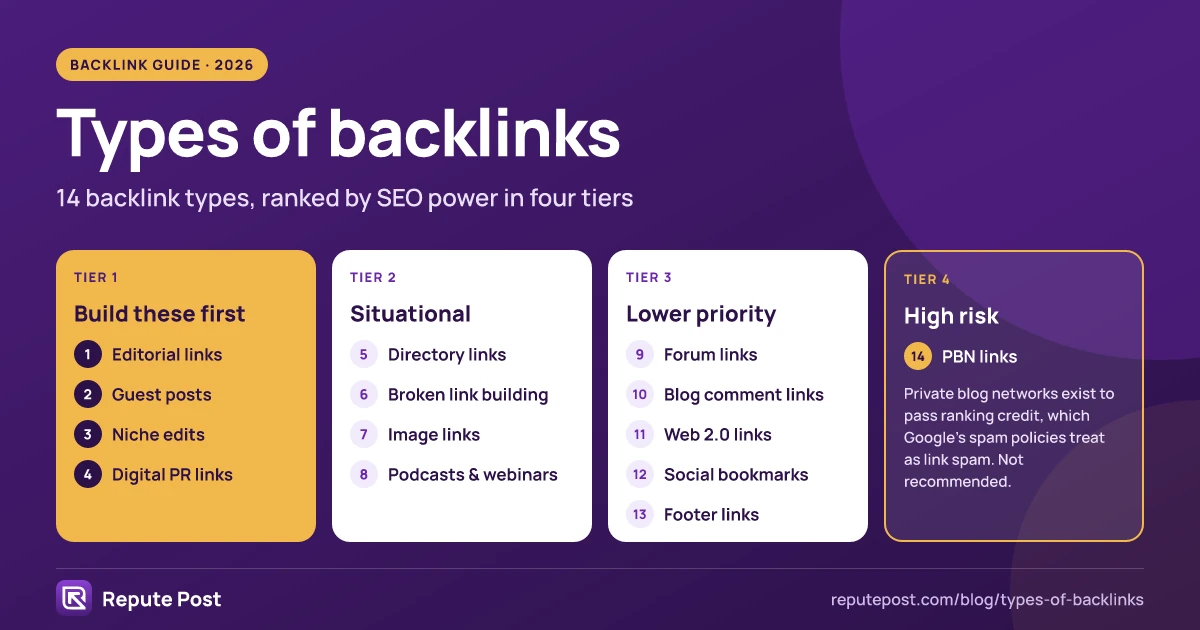
The 14 types of backlinks in this guide, ranked by SEO power in four tiers.
What are the 3 types of backlinks?
The different types of backlinks in SEO fall into three groups, based on how the link gets onto the page. That's why some guides talk about 3 types of backlinks while others list dozens: they group the same links in different ways.
Earned links. Another site links to you because your content is worth citing. Nobody asked or paid. Editorial links, digital PR links and image credits belong here.
Built links. You pitch, ask or pay a site owner, and they place the link. Guest posts, niche edits, broken link replacements, podcast and webinar links and footer credits belong here.
Self-created links. You add the link yourself on a platform that lets anyone post. Directory listings, forum posts, blog comments, web 2.0 blogs, social bookmarks and PBN links belong here.
You can also sort a backlink type by its HTML attribute (dofollow, nofollow, sponsored or UGC) or by where it sits on the page: in the body text, a sidebar, a footer or an image. Those groupings cut across the three above. A guest post link can be dofollow or sponsored, and an image link can be earned or built.
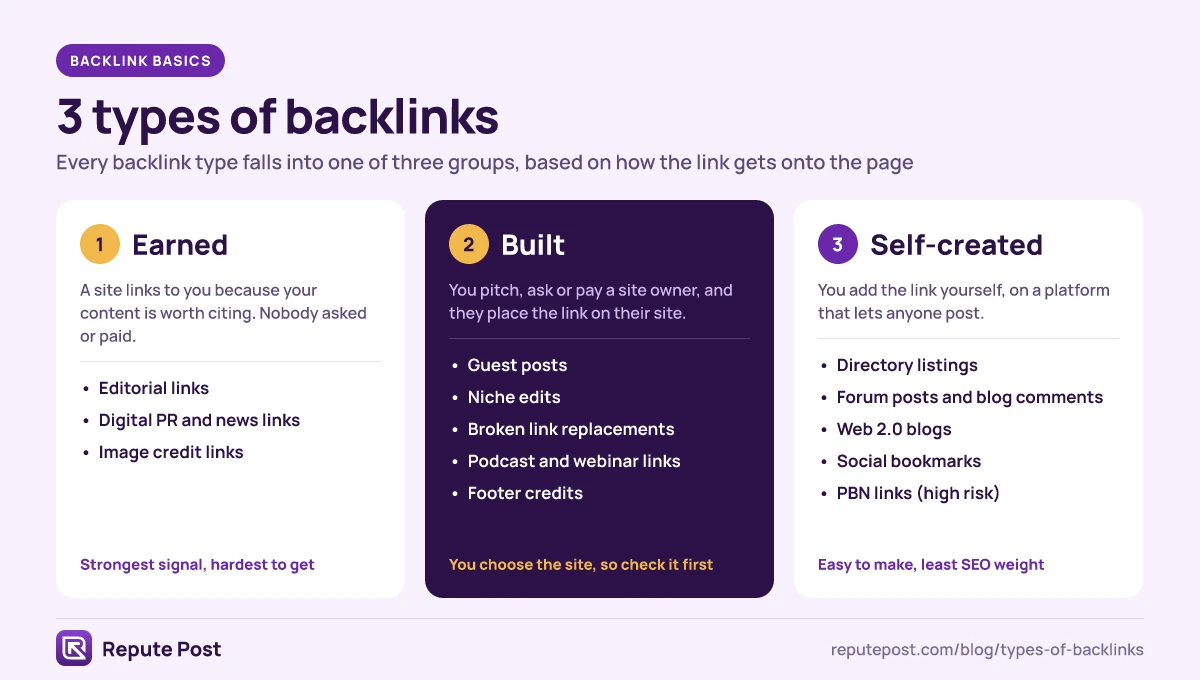
The 3 types of backlinks, grouped by how the link gets onto the page.
What makes a backlink count
Before ranking anything, it helps to know what separates a valuable backlink from a wasted one. A backlink is more likely to help your rankings when:
It comes from a site with real organic traffic. A high domain rating on its own proves little.
It sits inside content on a related topic.
The anchor text reads naturally and describes the page it points to.
It's a dofollow link. A healthy link profile still has some nofollow links mixed in.
The site owner placed it because it helps their readers, and its main purpose isn't to move rankings.
The backlink ranking below scores each type against these checks. The most effective backlink types usually pass all five, while the weakest pass one or two. That's why some types rank higher than others, even when both are real, live links.
Backlink types list: all 14 at a glance
Here is the full list. Use it as a quick backlinks list for briefs, audits or client calls, with one line on what each type is.
Editorial backlinks are placed by another site's author because your content earned it. The single most valuable type.
Guest post backlinks come from articles you write for another site's blog, with the link in the body or author bio.
Niche edit / contextual backlinks are added to existing articles on another site that are already indexed and ranking.
Digital PR / news backlinks come from press coverage, data studies or expert comments picked up by journalists.
Directory backlinks come from business listings and industry directories.
Broken link backlinks replace a dead link on another site with a link to your equivalent, working page.
Image backlinks are earned when another site credits or links to an image, infographic or photo you created.
Podcast and webinar backlinks come from appearing as a guest or speaker, usually linked in show notes or a bio.
Forum backlinks are links placed inside forum posts or replies.
Comment backlinks are links left in a blog or website's comment section.
Web 2.0 backlinks come from content published on free platforms such as Blogger or WordPress.com.
Social bookmarking backlinks come from saving or sharing a page on platforms such as Reddit or Pinterest.
Footer backlinks sit in a site's footer, often as part of a service credit or partnership.
PBN backlinks come from a private network of sites built to pass link authority. High risk and not recommended.
Tier 1: The types worth building first
1. Editorial backlinks
An editorial backlink is a link another site adds because your content helps its readers. Nobody asked for it, and nothing was exchanged for it. It's the hardest type to fake, which is exactly why it carries the most weight.
Example: A finance blog publishes an original survey on remote work spending habits. A writer covering the same topic finds the data useful and links to it as a source.
How it's earned: Original research, detailed guides and useful tools earn these links over time, as these examples from real sites show. No outreach template replaces having something worth citing.
Why it ranks first: It's the closest thing to a real vote of confidence that a search engine can measure.
2. Guest post backlinks
A guest post backlink comes from an article you write and publish on someone else's site, with a link back to your own site in the body or author bio.
Example: An SEO consultant writes a guest article for a marketing blog about one specific tactic, with a natural link to a related resource on their own site.
How it's earned: Outreach to relevant, active blogs, a useful pitch and an article written for the host site's audience. A guest post marketplace skips the outreach: you filter sites by niche, traffic and DR, see the price and order.
Why it ranks high: It combines referral traffic with a real editorial placement, as long as the host site is relevant and the article is worth reading on its own.
Google's spam policies list "links with optimized anchor text in articles, guest posts, or press releases distributed on other sites" as an example of link spam. So Google's view on guest posting comes down to how you write the link. Use a natural anchor, and write for the host site's readers first.
3. Niche edit / contextual backlinks
A niche edit is a link added to an article that's already published, indexed and ranking on someone else's site, so no new post is needed. You'll also see niche edits called link insertions or curated links.
Example: A blog post from a couple of years ago about home office setups gets a new sentence linking to a relevant product page.
How it's earned: Usually through a paid or negotiated placement with the site owner, since the content already exists and already ranks.
Why it ranks high: The host page is already indexed and getting traffic, so your link goes live on a page Google already knows. A brand new guest post still has to be crawled, indexed and ranked first.
4. Digital PR and news backlinks
These backlinks come from press coverage, expert commentary or data-driven stories that journalists and publications pick up and cite.
Example: A company runs a small industry survey and pitches the results to relevant publications, which cover the findings and link to the original data.
How it's earned: A newsworthy angle, real data or a strong expert quote, plus outreach to journalists and writers who cover that beat.
Why it ranks high: The links come from news sites and established publications, so they build brand visibility alongside SEO value.
Tier 2: Situational, but legitimate
5. Directory backlinks
A directory backlink comes from listing your business in an industry or general business directory.
Example: A local plumbing company lists itself on a home services directory with its service area and contact details.
How it's earned: Submitting to relevant, actively maintained directories and skipping the spam-filled ones.
Why it's situational: Directories help local businesses and add variety to a link profile, but their impact is low if they're your only strategy. Google's spam policies name low-quality directory links as link spam, so directory link building only pays off on directories that real people use.
6. Broken link backlinks
This method means finding a dead link on another site and suggesting your working, relevant page as a replacement.
Example: A resource page links to a guide that no longer exists. You point out the dead link and offer your own similar guide in its place.
How it's earned: Find relevant broken links with a backlink checker or crawler, then send the site owner a short, helpful email. The same tools work on your own site, and this walkthrough explains what to do when links to your pages break.
Why it's situational: Success rates are low and the outreach takes time. The links you do win are often high quality, because they replace content the site owner already valued.
7. Image backlinks
An image backlink is earned when another site credits or links to an image, infographic or photo you created.
Example: A travel blog uses your original destination photo and credits your site with a linked caption.
How it's earned: Creating visuals worth sharing and making it easy for others to find and credit the source.
Why it's situational: Good for visibility, but the link often sits on the image itself. When an image is the link, Google uses its alt text as the anchor text, so ask for a text credit as well. That gives the link words that describe your page.
8. Podcast and webinar backlinks
These come from appearing as a guest speaker or interviewee, with a link in the show notes, the description or your bio.
Example: An SEO specialist appears on a marketing podcast, and the episode notes link to their site next to their bio.
How it's earned: Pitching relevant podcasts and webinars in your industry and turning up with something useful to say.
Why it's situational: Good for referral traffic and credibility. The SEO value depends on whether the link is dofollow and where it sits on the page.
Tier 3: Lower priority today, still has narrow use cases
9. Forum backlinks
A forum backlink is placed inside a post or reply on a discussion forum or Q&A site.
Example: Someone answers a specific question in an industry forum thread and links to a relevant page on their site as further reading.
How it's earned: Taking part in relevant communities and answering real questions instead of dropping links.
Why it's lower priority: Google asks sites to mark links in forum posts with ugc or nofollow, and its spam policies name forum posts with optimized links as link spam. Treat forum links as a way to reach people in your niche, with any ranking effect as a bonus.
10. Comment backlinks
A comment backlink is a link left in the comment section of a blog post or article.
Example: Leaving a thoughtful, relevant comment on an industry blog post, with a link to a related resource where it adds to the discussion.
How it's earned: Reading and engaging with real content, never posting generic comments just to drop a link.
Why it's lower priority: WordPress adds rel="nofollow ugc" to links inside comments by default, so a comment link on a WordPress blog is nofollow unless the owner changes that. Google's spam policies also count links made with automated programs as link spam, so never use a tool to post blog comment backlinks at scale. Written by hand and used sparingly, comments can still bring a trickle of referral traffic.
11. Web 2.0 backlinks
A web 2.0 backlink comes from content you publish on a free publishing platform such as Blogger or WordPress.com.
Example: Publishing a short article on a free blogging platform with a link back to your main site.
How it's earned: Creating an account on a free platform and publishing content. It needs no outreach and no approval from anyone else.
Why it's lower priority: Anyone can create these without earning anything, which is why they sit low in this ranking. A few web 2.0 sites are still useful for brand visibility and a varied link profile, as long as you use them sparingly.
12. Social bookmarking backlinks
These come from saving or sharing a page on social bookmarking or content discovery platforms such as Reddit or Pinterest.
Example: A useful guide gets shared and upvoted on a relevant subreddit, bringing a link and referral clicks.
How it's earned: Sharing useful content on platforms where your audience already spends time.
Why it's lower priority: Google's spam policies list low-quality bookmark site links as an example of link spam. The real benefit is referral traffic and visibility, so judge a share by the visits it brings.
13. Footer backlinks
A footer backlink sits in a website's footer, often as part of a partnership, sponsorship or service credit.
Example: A web design agency asks for a small footer credit link on client sites it has built.
How it's earned: Usually agreed as part of an existing business relationship instead of earned through content.
Why it's lower priority: A footer link gets less attention than an in-content link, and Google's spam policies list "widely distributed links in the footers or templates of various sites" as link spam. One credit on a site you built is normal. The same keyword-rich link across hundreds of sites is the pattern to avoid.
Tier 4: High risk
14. PBN backlinks
A PBN (private blog network) backlink comes from a group of websites, often built or bought specifically to link back to one main site and pass authority.
Example: A collection of aged domains, each with a handful of pages, all linking back to the same target site.
How it's earned: Built and controlled by whoever owns the network, with no outreach and no editorial choice by an outside site.
Why it's high risk: Google's spam policies define link spam as creating links "primarily for the purpose of manipulating search rankings", which is the reason a PBN exists. If Google finds a pattern of unnatural links to your site, it can apply a manual action to some or all of the site, and you'll see it in the Manual Actions report in Search Console. Not recommended under any circumstances.
Link attributes: dofollow vs nofollow, sponsored and UGC
Every backlink also carries one of four link attributes, which tell search engines how to treat it. The attribute is separate from the backlink type. A guest post link and a comment link can both be nofollow, even though you get them in completely different ways.
Dofollow: a regular link with no
relvalue. Google can crawl it and use it as a signal for the page it points to.Nofollow:
rel="nofollow", for links you don't want to vouch for.Sponsored:
rel="sponsored", for ads and paid placements.UGC:
rel="ugc", for links that users add, such as comments and forum posts.
Google says links marked nofollow, sponsored or ugc "will generally not be followed", according to its guide to qualifying outbound links.
The attribute matters most when money changes hands. Google's spam policies treat buying or selling links for ranking purposes as link spam, and they allow paid links that are marked rel="sponsored" or rel="nofollow". On the ReputePost marketplace you pick the link type (dofollow, nofollow, sponsored or UGC) when you order.
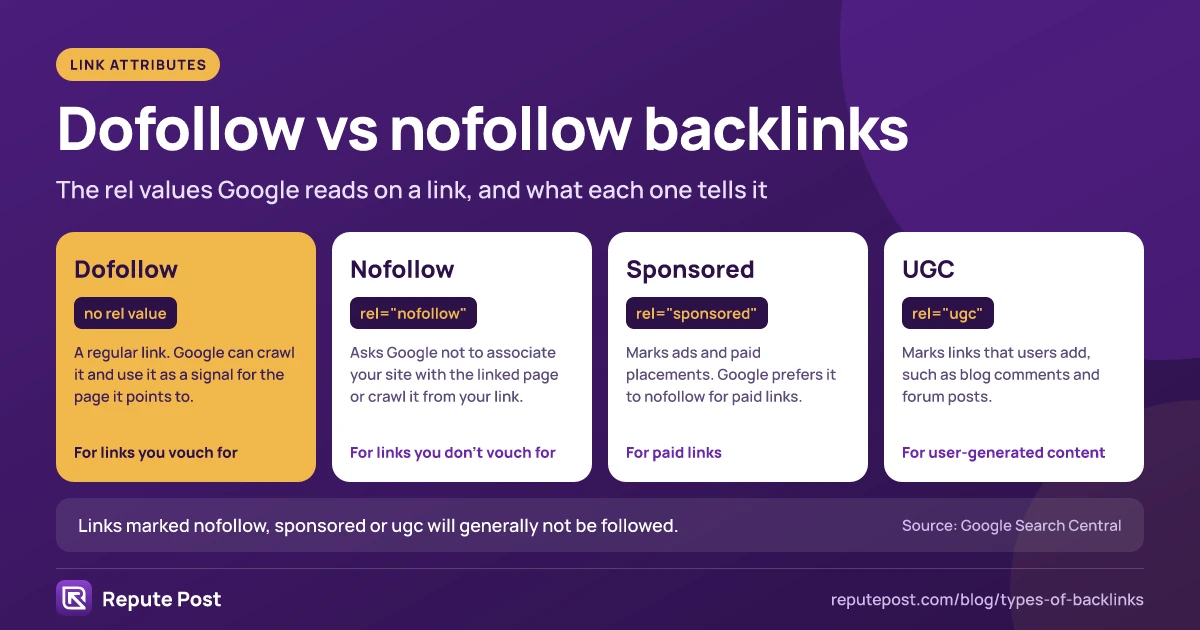
Dofollow vs nofollow, sponsored and UGC: the four values Google reads on a link.
To see which attribute a link has, right-click it and choose Inspect. The short video below shows that check and two other free ones. For every link pointing to your site at once, a dofollow backlink checker is faster.
Video (1:28): how to check if a link is dofollow or nofollow, three free ways.
Backlink types compared
Use this table to weigh your backlink options side by side. Costs are shown as ReputePost's own prices where ReputePost sells that type. The other types cost your time, or whatever a PR agency or directory charges.
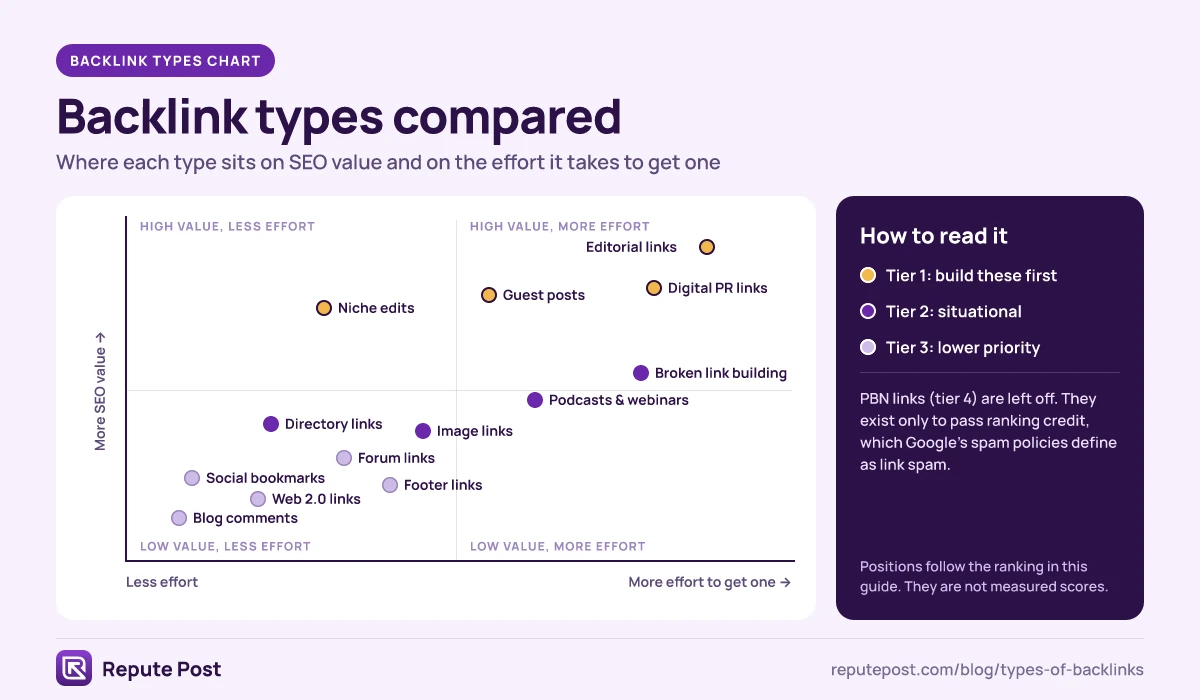
Backlink types compared by SEO value and effort. Positions follow the ranking in this guide, and PBN links are left off.
Type | Tier | How you get it | Cost | Main risk | Best use case |
|---|---|---|---|---|---|
Editorial | 1 | Earned | Free (your time) | Slow to build | Building topical authority |
Guest post | 1 | Built | From $6.50 on ReputePost's guest post marketplace | Off-topic or low-traffic host sites | Referral traffic and authority |
Niche edit / contextual | 1 | Built | $89 to $499 per placement through niche edits from ReputePost | Host pages with no traffic | Fast authority on an existing page |
Digital PR / news | 1 | Earned | Campaign time or a PR budget | Coverage is hard to predict | Brand visibility and authority |
Directory | 2 | Self-created | Free or a listing fee | Low-quality directories | Local SEO and niche relevance |
Broken link | 2 | Built | Free (outreach time) | Low reply rates | Rebuilding lost link equity |
Image | 2 | Earned | Free (time to make visuals) | Use without a credit | Visual content promotion |
Podcast / webinar | 2 | Built | Free (your time) | Nofollow show notes | Credibility and referral traffic |
Forum | 3 | Self-created | Free | Seen as spam if overdone | Niche visibility |
Comment | 3 | Self-created | Free | Little ranking value | A trickle of referral traffic |
Web 2.0 | 3 | Self-created | Free | Thin content | Profile diversity |
Social bookmarking | 3 | Self-created | Free | Little ranking value | Referral spikes |
Footer | 3 | Built | Negotiated | Sitewide link patterns | Partnership visibility |
PBN | 4 | Self-created | Varies | Manual action | Not recommended |
Publishers set their own guest post prices on ReputePost, and guest posts start at $6.50. On sites with DR 20+ and at least 1,000 monthly organic visitors, the median price publishers set was $100 on 10 November 2026, and this price breakdown splits it by traffic and DR. Niche edits come in six DR tiers: DR30+ for $89, DR40+ for $129, DR50+ for $189, DR60+ for $259, DR70+ for $349 and DR80+ for $499 per placement.
Run a SaaS product? ReputePost's SaaS backlinks are the same contextual type as a niche edit, placed in existing, indexed articles on SaaS and service websites. They come in three tiers: DR30-55 for $149, DR56-75 for $199 and DR76-92 for $249 per placement.
Frequently asked questions
How many types of backlinks are there in SEO?
There's no fixed number. It depends on how you group them: by how you get them (earned, built or self-created), by attribute (dofollow, nofollow, sponsored or UGC) or by where they sit on the page. A list that names every platform separately can stretch to 50 types of backlinks or more. This guide covers the 14 that matter most for a real link building strategy.
What is a backlink type?
A backlink type describes how a link was earned and where it sits, for example an editorial link, a guest post link or a footer link. The type tells you how much SEO value to expect from the link and how much risk comes with it.
What is the most powerful type of backlink?
Editorial backlinks, placed by another site because your content earned them. They're the hardest to manufacture and the clearest sign that another site trusts your page. Among the types you can build yourself, the best types of backlinks are guest posts and niche edits on relevant sites with real organic traffic.
Which types of backlinks are outdated today?
Web 2.0, comment and forum backlinks still exist and still get built, but they sit low in this ranking because anyone can create them. They aren't spam by default, and they work best as a small part of a varied profile instead of a primary strategy.
Are backlinks still relevant in 2026?
Yes. Google's own documentation says it uses links as a signal when it judges how relevant a page is, and to find new pages to crawl. What has changed is which types carry weight. Quality and relevance now matter far more than raw volume.
Do you need every type of backlink, or just a few?
No single business needs all types of backlinks. A natural link profile usually leans on editorial, guest post and niche edit or contextual links, with a smaller mix of the other types added over time for variety.
Building a backlink profile that works
The types at the top of this list (editorial, guest post and niche edit or contextual backlinks) do the most work for your rankings. The types further down still have a place in a natural, varied profile, as extras around that core.
Whichever types you buy, check the site first. Every site on the ReputePost marketplace is reviewed by hand before it's listed, and it must show 1,000+ organic visitors, an Ahrefs DR of 20 or higher, rankings for real keywords and no history of Google penalties or manual actions. For niche edits, the team checks the linking page's organic traffic, spam score, referring domains and topical relevance before a link goes in, and a removed link is replaced free.
Building links on behalf of clients? ReputePost's white label link building delivers guest posts and niche edits under your agency's name, with reports that carry your branding.
Related articles
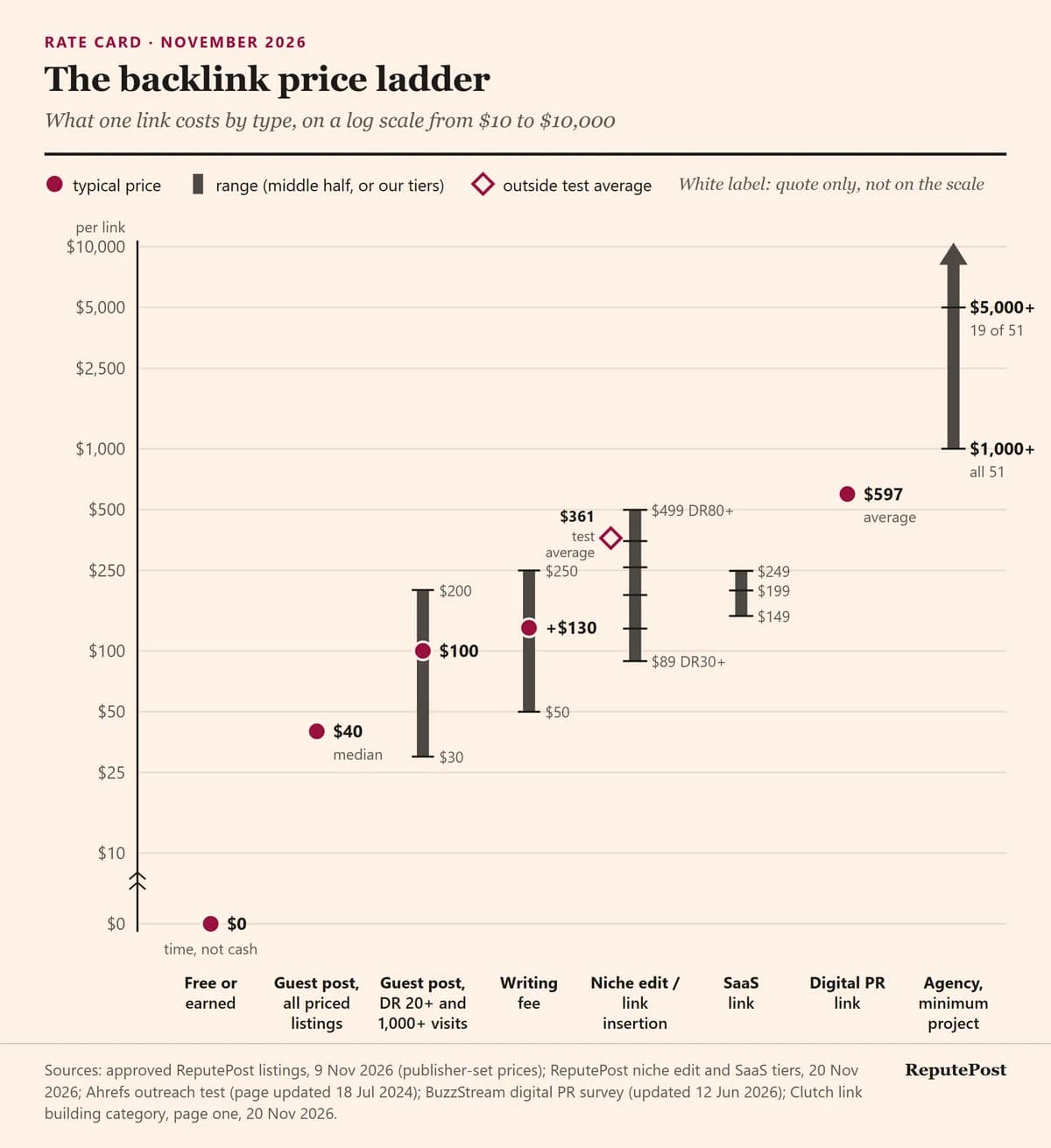
How Much Do Backlinks Cost? Prices by Link Type in 2026
Most backlinks cost $0 to about $600 in November 2026. Our 15,812 listings show traffic, not DR, sets a guest post's price. Rate card, budgets and checks.
15 min read
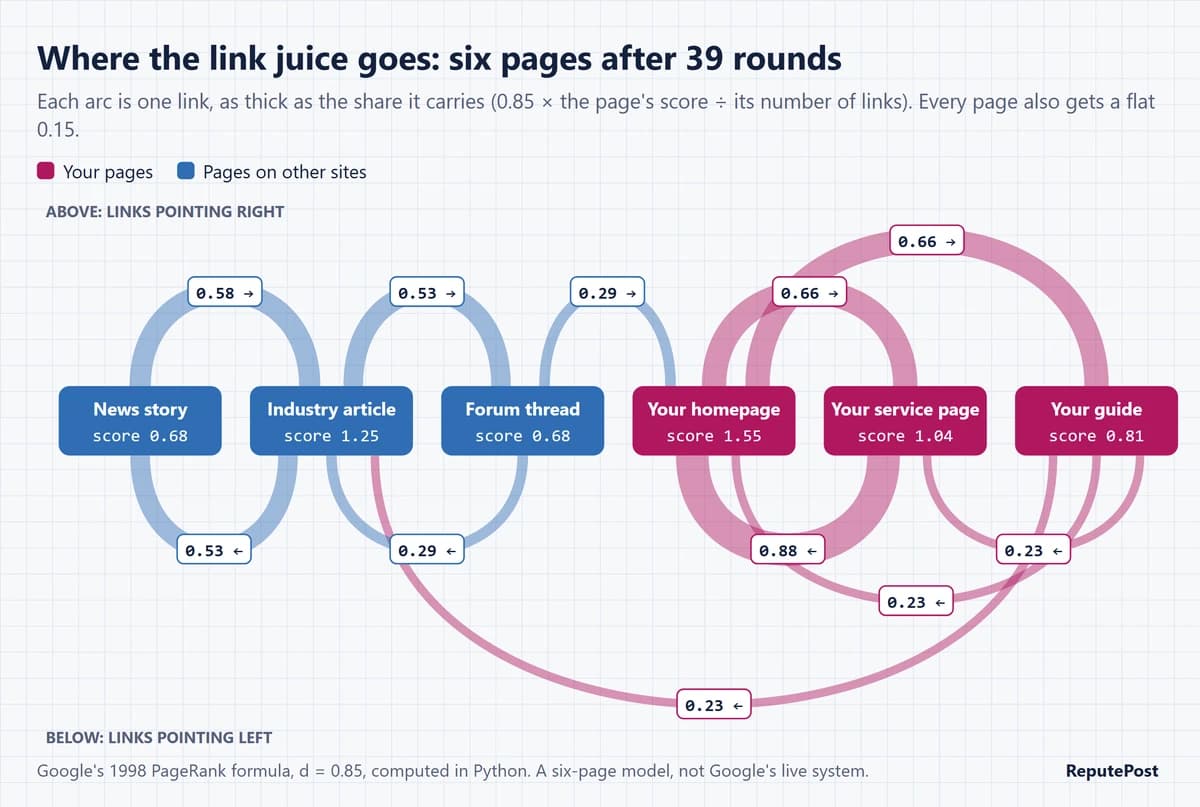
Link Juice in SEO: How Backlink Juice Flows
Six pages, Google's 1998 PageRank formula and 39 rounds in Python: where link juice flows, what nofollow, redirects and crowded pages do to it, and which links carry the most.
19 min read
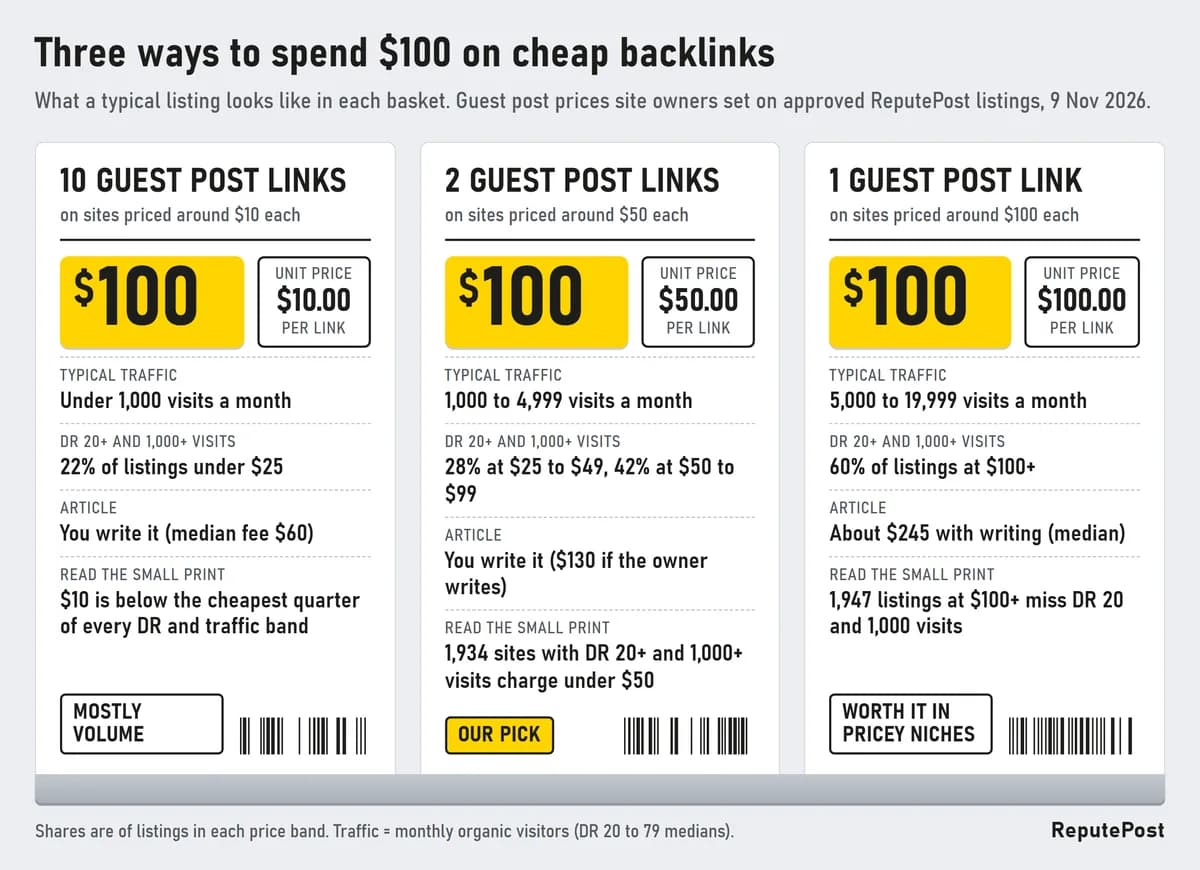
Cheap Backlinks: What $10, $50 and $100 Really Buy
Ten $10 links, two $50 links or one $100 link? We sorted 15,812 approved listings by price to show what cheap backlinks really buy, the red flags in cheap offers, and how to buy safely.
19 min read